
Career Growth Guide: Skills, Jobs, and Salary Growth (UpCareerNow)
HOW THIS PAGE IS DIFFERENT
Most career advice talks in motivation or generic tips. This career growth guide focuses on decision clarity—showing how skills, career paths, and salary growth actually connect, so you can plan career growth step by step without guesswork.
Career growth is the process of improving your skills, increasing your responsibilities, and moving toward better roles and higher pay over time. This career growth guide helps you choose a career path, build skill development in the right order, and understand what salary growth usually looks like—without hype.
If college isn’t the right path for you, explore high-paying careers without a degree that focus on skills, proof of work, and long-term career growth.
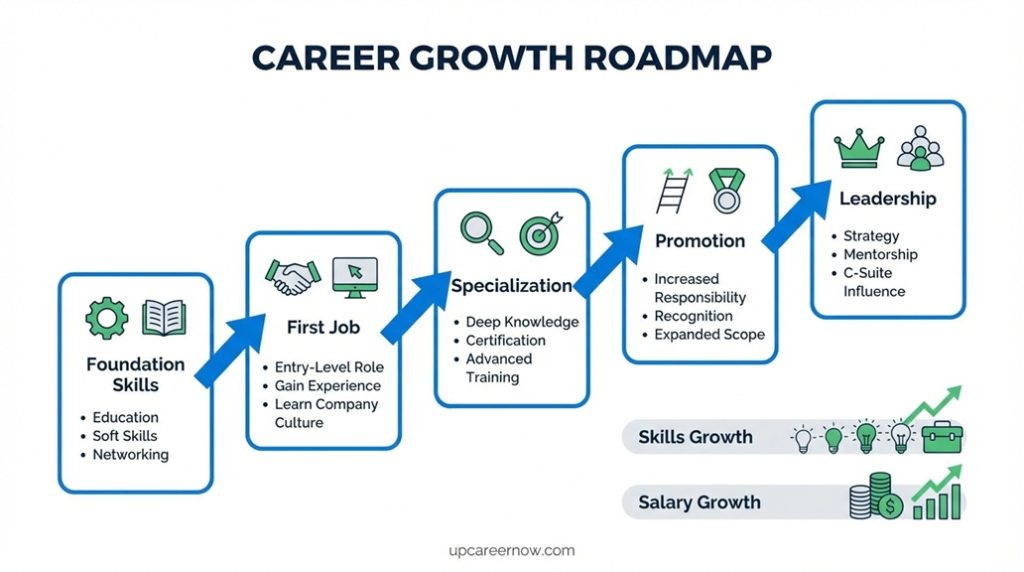
Key Takeaways
- Career growth becomes easier when you pick a clear career path and measure progress
- Skill development is the fastest way to create career growth leverage
- Salary growth usually follows responsibility growth and specialization
- Promotions depend on proof, communication, and timing—not effort alone
- Avoiding common mistakes can speed up career growth dramatically
Who This Guide Is For
- People planning career growth from scratch (students and beginners)
- Job seekers building a career path planning strategy
- Professionals aiming for salary growth or a promotion
- Career switchers who want skill development with less risk
Quick Answer
Career growth improves fastest when you choose one direction, build role-relevant skills, create proof of work, and target opportunities where salary growth matches your level.
What Career Growth Means in Real Life
Career growth is not just getting promoted or earning more money. In real life, career growth means increasing your value, scope of responsibility, and long-term opportunities so your career path stays flexible and resilient—even when industries change.
In practical terms, career growth usually shows up as one or more of these changes:
- You handle more complex problems than before
- Your skills become harder to replace
- Your role influences bigger decisions or outcomes
- Your compensation improves because your impact increases
Many people confuse career growth with job changes. While switching roles can help in some cases, sustainable career growth comes from skill development, better positioning, and choosing a career path that allows progression. Changing jobs without growing responsibility often resets progress instead of accelerating it.
Another common confusion is career growth vs job security. Job security is about staying employed, while career growth is about staying valuable. A role can feel secure in the short term but still limit long-term career growth if skills stop evolving or responsibilities stay narrow.
Career growth is also different from career satisfaction. Enjoying your work matters, but satisfaction alone does not guarantee career development. Long-term career growth usually requires building skills that are useful beyond one team, manager, or employer.
Career growth also looks different at each stage:
- Early stage: learning fundamentals, building reliability, and understanding expectations
- Mid stage: specialization, ownership of outcomes, and visible impact
- Later stage: leadership, strategy, or high-impact expertise
Understanding these differences prevents one of the biggest mistakes in career development—chasing titles instead of building leverage. Real career growth compounds when your skills, responsibility, and impact increase together.
Salary growth usually follows responsibility and impact, not job titles. This is why choosing the right skills with high earning potential matters more than chasing trends.
Career Growth in 10 Seconds: The Simple Model
Career growth follows a simple pattern that applies to most roles and industries:
Skills → Responsibility → Results → Recognition → Salary Growth
Here’s how this model works in real life:
- Skills create your ability to take on more work
- Responsibility expands when others trust your capability
- Results prove your value in measurable ways
- Recognition leads to promotions, better roles, or new offers
- Salary growth follows once your impact is visible
If career growth feels slow, one of these steps is usually missing. For example, strong skills without visible results rarely lead to recognition, while results without communication often delay salary growth.
Career growth doesn’t always show up immediately in your paycheck. Pay usually increases after responsibility and impact grow—not at the same time. We explain this delay and how compensation actually changes in our guide to salary growth.
Where people usually get stuck
- Skills but no responsibility: you’re learning, but your role never changes because you haven’t asked for bigger scope or shown readiness.
- Responsibility but weak results: you’re busy, but outcomes aren’t clear, measurable, or consistent.
- Results but no recognition: you deliver, but your impact isn’t visible to decision-makers because you don’t document or communicate it.
A quick example (generic, but realistic)
Imagine you improve a workflow and save time for your team. That’s a result—but career growth only happens if:
- you can explain what changed,
- show the impact (time saved, errors reduced), and
- connect it to business goals.
This model keeps career development practical and prevents common misunderstandings about how people actually advance in their careers. When in doubt, ask: Which step am I missing right now? That question alone improves career growth decisions.
Decision Inputs & Outcomes
This table helps you understand which inputs you control and what career growth outcomes they typically lead to. Career growth improves when the right inputs are applied consistently.
| Career Growth Input | What It Means | Typical Outcome |
|---|---|---|
| Skill development | Learning role-relevant, in-demand skills | Faster career growth opportunities |
| Career path planning | Choosing roles with clear progression | Reduced career stagnation |
| Proof of work | Projects, results, or measurable output | Higher trust and responsibility |
| Communication | Sharing progress and results clearly | Recognition and promotion readiness |
| Consistency | Repeating effort over time | Sustainable salary growth |
| Positioning | Targeting the right roles and teams | Better job offers and mobility |
Most career growth problems happen when effort is high but inputs are misaligned—for example, building skills that don’t support your chosen career path.
Step-by-Step Career Growth Roadmap
If you want career growth without guessing, follow this simple roadmap. It works for most career paths because it focuses on skill development, proof, and progression.
Step 1: Pick one career direction (not five)
Career growth accelerates when your effort is concentrated. Choose a career path where you can realistically build skill development and show results within 3–6 months.
Quick check: If you can’t explain your target role in one sentence, your career path planning is still unclear.
Step 2: Identify the “entry requirements” that actually matter
For many roles, the real entry requirement isn’t a degree—it’s proof you can do the work. List the top 5–8 skills, tools, or responsibilities common in entry-level job descriptions for your path.
How to read job descriptions correctly (this saves months):
- Look for repeated phrases across multiple listings (that’s the real requirement)
- Separate “must-have” skills from “nice-to-have” skills
- Notice what the role produces (reports, designs, support, sales outcomes, process improvements)
- Identify the tools mentioned most often (even if you don’t master them yet)
Career growth improves faster when your skill development matches what the market actually asks for.
Step 3: Build skill development in the right order
Start with fundamentals, then layer specialization. Career development breaks when people jump to advanced topics without a foundation.
A simple order:
- Core fundamentals
- Common tools/workflows
- Practice through small projects
- One specialization area
Quick check: If you can’t explain the basics clearly, you’re not ready to specialize yet.
Step 4: Create proof of work (your credibility engine)
Proof converts skill development into career growth. Your proof can be:
- projects
- case studies
- process improvements
- measurable outcomes
Proof-of-work examples (not just for tech):
- Customer support: reduced response time, improved satisfaction, created a better FAQ process
- Operations/admin: streamlined a workflow, reduced errors, built a tracking sheet that improved delivery
- Marketing: improved engagement metrics, built a content plan, documented results from experiments
- Sales: tracked conversion improvements, improved follow-up process, created a pitch guide with outcomes
The goal is simple: make it easy for someone to trust your ability.
Step 5: Get feedback and improve fast
Feedback prevents wasted months. Use mentors, peers, or realistic self-review to fix weak points early—this supports faster career growth.
Quick check: If you repeat the same mistake for weeks, you’re missing feedback.
Step 6: Apply strategically, not emotionally
Target roles that match your current proof and skills. Random applications slow career development and often stall salary growth.
A strategic approach:
- apply to roles that match your current level
- customize your resume summary to match the target career path
- highlight proof of work that matches role outcomes
Step 7: Track career growth like a system
Every month, review:
- what skill development you completed
- what proof you created
- what opportunities you applied for
- what improved in your outcomes (interviews, responsibilities, salary growth)
Simple monthly career growth review (copy this):
- What did I learn that directly supports my career path?
- What proof did I create that shows ability (not effort)?
- What result can I measure or explain clearly?
- What feedback did I receive—and what changed because of it?
- What is the next skill that increases responsibility?
This makes career growth measurable and repeatable—so your career development becomes a system, not a hope.
Skill Development That Drives Career Growth
Not all skills create the same career growth. The fastest career growth comes from skills that increase responsibility, not just knowledge.
Here’s how to think about skill development strategically:
Foundational skills (required for entry)
These allow you to enter a career path and be functional.
- Core technical or role-specific skills
- Basic communication and problem-solving
- Understanding workflows and expectations
Without these, career growth stalls early.
Leverage skills (accelerate career growth)
These skills expand your scope and visibility.
- Decision-making
- Prioritization
- Cross-functional communication
- Process improvement
Leverage skills often separate people who grow steadily from those who plateau.
Specialization skills (increase salary growth)
Specialization creates scarcity, which supports salary growth.
- Deep expertise in one area
- Ownership of complex tasks
- Ability to mentor or guide others
Career growth accelerates when specialization aligns with business needs.
Transferable skills (protect long-term career growth)
Transferable skills keep your career path flexible.
- Writing and documentation
- Analytical thinking
- Teaching and explaining concepts
- Adaptability to new tools or environments
Strong transferable skills reduce risk during career changes.
Why learning speed matters more than learning volume
Many people collect skills but still struggle with career growth because learning stays “theoretical.” Skill development creates career growth when it becomes usable under real conditions.
A practical way to improve learning speed:
- learn one concept
- apply it immediately
- document what changed
- repeat until results are consistent
This prevents skill decay and makes your career development more efficient. It also ensures your career path planning is backed by proof—not just intention.
Key insight:
Career growth improves fastest when skill development moves from foundational → leverage → specialization, instead of trying to learn everything at once.
Not all skills create the same outcomes—some skills scale much faster than others. See our breakdown of high-income skills and why certain skills consistently lead to stronger career and salary growth.
Salary Growth: What’s Realistic and What’s Not
Salary growth is one of the most misunderstood parts of career growth. In most careers, salary growth follows responsibility and impact, not time spent in a role.
Here’s what’s realistic in real-world career paths:
What usually drives salary growth
- Taking ownership of larger or more complex work
- Solving problems that directly affect outcomes
- Developing skills that are harder to replace
- Moving from execution to decision-making
When these factors increase, salary growth usually follows.
What does NOT reliably drive salary growth
- Staying longer in the same role without new responsibilities
- Collecting unrelated skills without proof
- Waiting for recognition without communicating results
- Changing jobs too frequently without progression
These patterns often slow career growth instead of accelerating it.
Why salary growth often lags behind your impact
Even when your skills improve, salary growth can take time because:
- employers adjust pay during review cycles, not instantly
- recognition often requires consistent results, not one good month
- responsibility changes first, then salary growth follows after proof is stable
This lag is normal. The goal is to make your impact obvious and repeatable.
Signals salary growth is likely coming
- Your responsibilities expanded in the last 60–90 days
- You’re trusted with higher-stakes tasks
- Others depend on your work to deliver outcomes
- Your results can be measured and explained clearly
Signals it’s time to reassess your career path
- Responsibilities never change despite skill development
- You consistently deliver but recognition never comes
- The role has a hard ceiling with limited growth tracks
- Your career growth depends entirely on waiting, not progression
Understanding these signals helps you plan career development more calmly and avoid frustration. Salary growth is often a result of alignment between skills, responsibility, results, and timing.
Some of the strongest salary growth opportunities come from careers without a college degree that reward measurable skills and responsibility over credentials.
Career Growth vs Salary Growth
Career growth and salary growth are related, but they don’t move at the same speed. Many people improve their skills and take on more responsibility long before their pay changes.
Salary usually increases after impact and trust are proven over time—not immediately when effort increases. Understanding this delay helps avoid frustration and poor career decisions.
If you want a clear explanation of how compensation actually changes, see our detailed breakdown of salary growth and what typically causes pay to increase.
Promotion Readiness Checklist
Promotion is one of the most visible signs of career growth, but it rarely happens by accident. Use this checklist to assess whether you’re truly ready for the next step in your career path.
You’re likely promotion-ready if:
- You consistently deliver results without close supervision
- Your skills support tasks beyond your current role
- You solve problems, not just complete assignments
- Others rely on your input or guidance
- You can explain your impact clearly and confidently
- Your work improves outcomes for a team or process
Signs you may need more preparation:
- Your skill development is broad but shallow
- Results are hard to measure or explain
- Feedback points to gaps in ownership or communication
- Career growth depends entirely on timing or luck
Using this checklist regularly helps you align skill development, responsibility, and visibility—three factors that strongly influence promotion and salary growth.
Real-World Career Growth Scenarios
Career growth becomes easier when you can see how the same principles apply in real situations. Here are common scenarios people face—and how to respond in a way that supports career development and salary growth.
Scenario 1: “I work hard, but my career growth is slow.”
This often means effort isn’t converting into visible results. Focus on:
- building proof of work
- tracking outcomes
- communicating impact clearly
Career growth improves when your contribution is easier to recognize.
Scenario 2: “I’m learning skills, but I’m not getting opportunities.”
Skill development without positioning is common. Fix it by:
- choosing one career path planning direction
- aligning skills with entry requirements
- creating a simple portfolio or evidence of work
Career growth accelerates when skill development matches market demand.
Scenario 3: “I want salary growth, but my role is capped.”
Some career paths have slower salary growth unless you specialize or change scope. Consider:
- specialization in a high-demand area
- moving toward roles with measurable impact
- targeting teams/industries with stronger growth tracks
Salary growth is often a structural issue, not just performance.
Scenario 4: “I’m switching careers and feel behind.”
Career change requires faster skill development and clearer proof. Start with:
- transferable skills you already have
- a short learning roadmap
- small projects that show readiness
Career growth during a career change improves when you reduce uncertainty for employers.
Scenario 5: “I’m close to promotion but keep getting overlooked.”
This is often a visibility and expectation gap. Try:
- asking what the next-level role requires
- documenting results and responsibilities
- taking ownership of one meaningful project
Promotion decisions usually follow clarity and proof, not assumptions.
Scenario 6: “I’m good at my job, but I don’t enjoy it.”
This is where career growth and career fit must be separated. You can grow quickly in a path that doesn’t suit you, but long-term career development becomes harder if motivation drops.
A practical way to respond:
- identify what you dislike (tasks, environment, pace, type of work)
- keep the transferable skills you gained
- shift your career path planning toward roles that match your strengths
- test alternatives through small experiments (side projects, short courses, trial responsibilities)
Career growth is not only about moving up—it’s also about moving toward work that you can sustain.
Common Career Growth Mistakes and Fixes
These mistakes are responsible for most stalled career development. Fixing even a few can improve career growth faster than “working harder.”
Mistake 1: Trying to grow in multiple directions at once
Fix: Choose one career path planning direction for 90 days. Focus your skill development and proof on that path.
Mistake 2: Learning skills without building proof
Fix: Convert every new skill into a small project, case study, or measurable output. Proof turns skill development into career growth.
Mistake 3: Skipping fundamentals and chasing advanced topics
Fix: Build a foundation first, then specialize. Career growth is usually slower when basics are weak.
Mistake 4: Measuring career growth only by salary
Fix: Track responsibility, problem complexity, and influence. Salary growth often lags behind these indicators.
Mistake 5: Applying randomly and hoping for results
Fix: Apply strategically to roles matching your current proof. Random applications waste time and slow career development.
Mistake 6: Poor communication of impact
Fix: Keep a simple “results log” and learn to explain outcomes in one minute. Recognition is a key step in career growth.
Mistake 7: Ignoring transferable skills
Fix: Strengthen writing, communication, and problem-solving. Transferable skills protect long-term career growth.
Mistake 8: Waiting too long to get feedback
Fix: Ask for feedback early and often. Small corrections prevent months of stalled career growth.
Why these mistakes matter:
Most career growth problems don’t come from laziness—they come from unclear career strategy. When skill development, proof, and positioning are aligned, career development becomes simpler. Fixing the “direction + proof + visibility” trio often unlocks career growth without adding more hours.
Alternatives and Next Steps
Career growth is not one-size-fits-all. If your current approach isn’t working, adjusting direction can unlock better career development and salary growth.
If your current role has limited career growth
- Explore adjacent roles that value your existing skills
- Look for teams or functions with clearer progression paths
- Add one specialization that increases your leverage
Sometimes career growth improves by shifting where you apply your skills, not abandoning them.
If your skills don’t match your target career path
- Identify transferable skills you already have
- Close the top 2–3 skill gaps first
- Build small proof-of-work projects before making a full switch
This reduces risk while keeping career development intentional.
If salary growth is your top priority
- Target roles with measurable impact and responsibility
- Focus on specialization rather than broad learning
- Choose environments where performance-based growth is common
Salary growth accelerates when your role directly affects outcomes.
If you’re unsure what to do next
- Review your career goals every 90 days
- Compare your skills against realistic role requirements
- Choose one clear experiment to test over the next month
Career growth improves when decisions are tested, not just planned.
A simple 30–60–90 day career growth reset plan
If you feel stuck, use this plan to restart career development without overwhelm:
- First 30 days: pick one career direction and build one foundational skill plus one proof example
- Next 60 days: improve the proof, get feedback, and add one leverage skill (communication, prioritization, or process improvement)
- By 90 days: target roles that match your updated proof and track whether interviews, responsibility, or salary growth signals improve
This keeps career growth measurable and prevents drifting.
When to Trust This Career Growth Guide
Use this checklist to decide when this career growth guide is most reliable for your situation.
This guide is a strong fit if:
- You want career growth through skill development and measurable progress
- You’re choosing a career path and need a practical roadmap
- You’re aiming for promotion or salary growth and want realistic expectations
- You prefer step-by-step career development strategies over vague motivation
- You can apply the roadmap consistently for at least 8–12 weeks
Use extra caution if:
- Your situation depends on strict local licensing rules (some trades/regulated roles)
- Your industry has unusual hiring cycles or requirements
- You’re making a high-stakes career decision without any feedback or data
This guide is designed for general career growth planning, so it works best when you combine it with real feedback, realistic role requirements, and consistent execution.
Limitations & Disclaimer
Career growth depends on many variables, including your skills, experience level, location, industry demand, timing, and consistency of effort. No single guide can account for every personal or market-specific factor.
Career information on UpCareerNow is provided for general guidance and planning purposes only. Actual outcomes depend on skills, experience, location, and market conditions.
This guide is designed to support informed decision-making, not to replace professional career counseling or employer-specific requirements.
Ad & Content Safety Note
This content is created for educational and informational purposes. It does not promise specific job outcomes, income levels, or promotions. Career growth varies by individual effort, skills, and market conditions, and readers should use this guide as a planning resource—not a guarantee.
Author Bio
Written by: UpCareerNow Career Research Team
Role: Career & Skills Analyst
The UpCareerNow Career Research Team focuses on skill-based hiring trends, career development frameworks, and long-term career growth patterns. Their work translates complex career decisions into clear, step-by-step guidance for students, job seekers, and professionals planning sustainable career growth.
FAQs
What is career growth in simple words?
Career growth means improving your skills and responsibilities over time so you qualify for better roles, stronger opportunities, and higher pay.
How can I improve career growth quickly?
Focus on one career path, build role-relevant skill development, create proof of work, and communicate results clearly. Consistency matters more than speed.
Does career growth always mean a promotion?
No. Career growth can also mean better skills, more responsibility, stronger projects, or moving into a better role—even without a title change.
How long does career growth usually take?
Career growth is gradual. Many people see meaningful progress in 8–12 weeks when skill development and proof of work are consistent.
How does career growth connect to salary growth?
Salary growth often follows responsibility and impact. When career growth increases your scope and results, salary growth is more likely over time.
Hey Google, how do I plan career growth step by step?
Choose one career direction, build skill development in order, create proof of results, and review progress monthly to keep career growth on track.
What slows career growth the most?
The biggest blockers are unfocused learning, no proof of work, weak communication of results, and applying randomly without a clear career path.
Is career growth possible without a degree?
Yes. Career growth can come from skill development, certifications, experience, and proof of work—depending on the career path you choose.
References
- U.S. Bureau of Labor Statistics — Career outlook and occupational growth data
- OECD — Employment and Skills Outlook reports
- World Economic Forum — Skills and workforce development insights
High-Income Skills: What Actually Pays Well (and Why)

Career Change Roadmap: How to Switch Careers Without Ruining Momentum
High-Paying Careers Without a Degree: Real Options
About The Author
