
High-Paying Careers Without a Degree: Real Options
What Makes These No-Degree Careers Worth Considering
Most job lists only name roles. This guide explains why certain high-paying careers without a degree pay well, what skills and proof matter most, and how to choose a no-degree career option based on realistic salary growth—not hype.
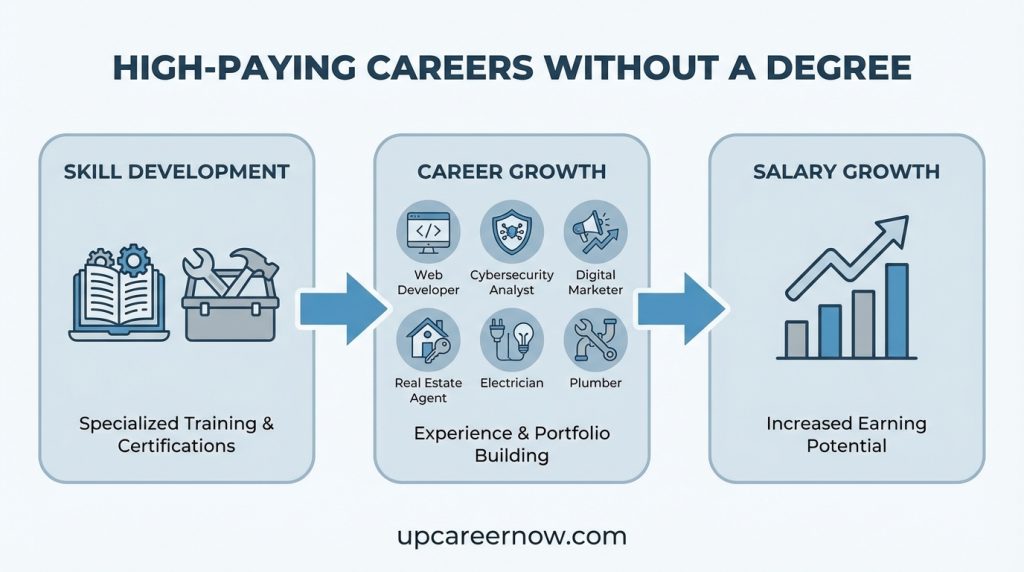
High-paying careers without a degree are roles where income potential depends more on skills, licensing, certifications, and real-world proof than on college credentials. If you choose the right path and build skill development in a focused way, you can create steady career growth and realistic salary growth over time.
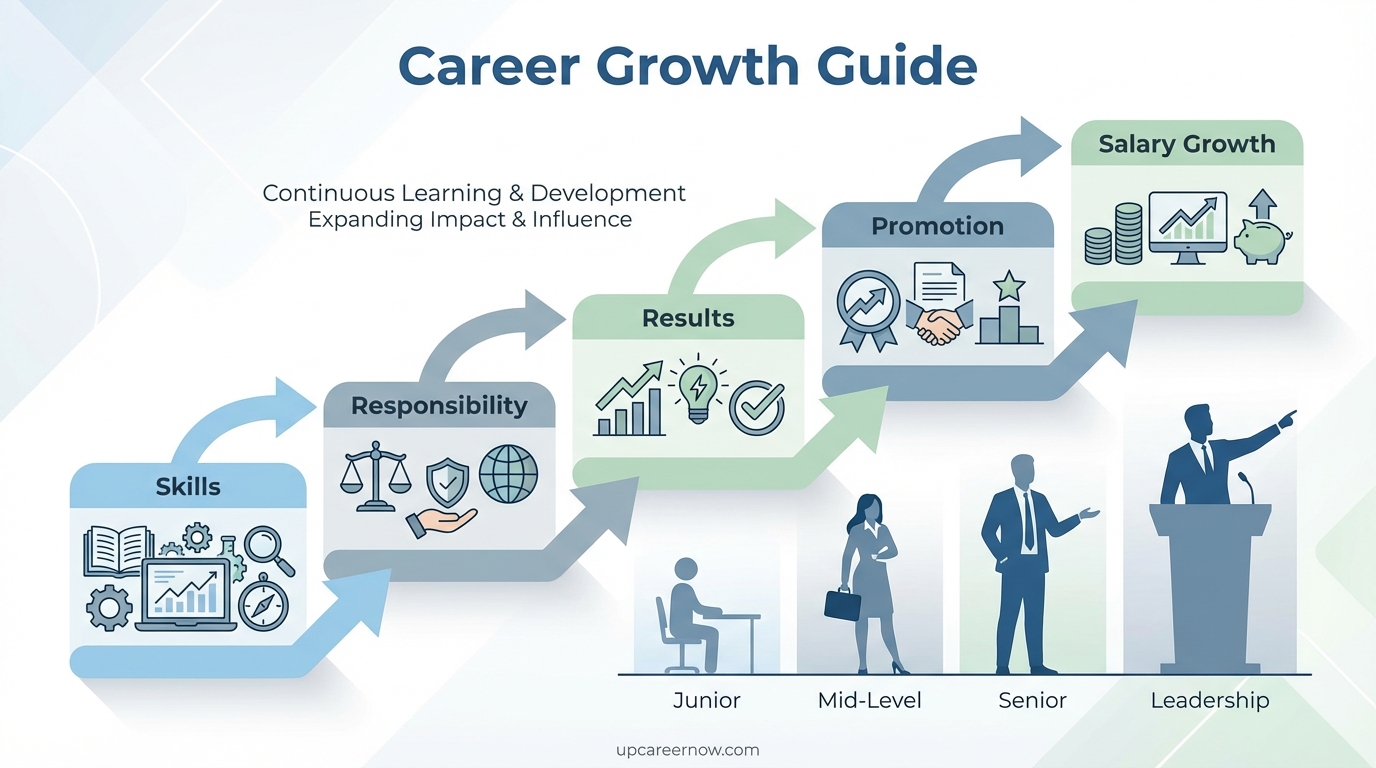
If you want a broader framework for planning long-term career growth, see our career growth guide for skills, salary progression, and promotion strategies.
Key Takeaways
- Many careers without a college degree pay well because they reward specialized skills and measurable output
- Salary growth is usually gradual; career development matters more than quick wins
- Your best no degree career options depend on your strengths and preferred work style
- Proof of work (projects, results, apprenticeships) can replace credentials
- Avoid common mistakes like chasing trends or learning without proof
Who This Is For
- People exploring careers without a college degree
- Students choosing a practical career path
- Career switchers looking for high paying jobs without a degree
- Anyone who wants a realistic plan for career growth without formal education
Quick Answer
To choose high-paying careers without a degree, pick a path with clear skill requirements, build proof of work, and target roles where responsibility and results drive salary growth.
What “High-Paying Without a Degree” Really Means
“High-paying careers without a degree” doesn’t mean instant high income. It usually means a career path where pay can grow strongly over time because the work is specialized, licensed, or performance-based—even if you don’t have a college credential.
In most cases, high paying jobs without a degree share at least one of these qualities:
- Skill scarcity: fewer people can do the work well
- Licensing or certification: formal proof replaces a degree
- Measurable output: results are easy to track (sales, projects, systems fixed, jobs completed)
- Clear progression: responsibility increases step-by-step, which supports salary growth
This is why many careers without a college degree pay well in trades, technology support roles, specialized operations, and certain sales paths. Career growth becomes realistic when you treat the path like a system: build skills, create proof, earn trust, then level up.
Quick Fit Check: Which Path Matches You?
Before choosing from high-paying careers without a degree, it helps to do a quick fit check. Career growth is faster when the work matches your strengths, work style, and tolerance for risk.
Use these questions to narrow your no degree career options:
Do you prefer hands-on or desk-based work?
- Hands-on: trades, technical maintenance, field roles
- Desk-based: tech support, design, analytics, digital operations
Do you like structured rules or flexible problem-solving?
- Structured paths often involve licensing, certifications, or apprenticeships
- Flexible paths reward creativity, decision-making, and performance
Are you comfortable with performance-based outcomes?
Some high paying jobs without a degree link income to results (sales numbers, projects delivered, clients handled). These paths can grow faster—but also require consistency and accountability.
How much time can you invest upfront?
- Short-term (3–6 months): entry-level support or assistant roles
- Medium-term (6–18 months): technical, creative, or licensed paths
- Longer-term (1–3 years): advanced trade or specialization roles
Answering these questions honestly helps you avoid choosing a career that looks good on paper but doesn’t support sustainable career growth.
Top High-Paying Careers Without a Degree
Below are realistic, high-paying careers without a degree where income potential grows with skills, responsibility, and proof—not college credentials. These options are chosen for stability, scalability, and clear entry paths.
| Career Path | Entry Focus (What Matters First) | Growth Potential |
|---|---|---|
| Web Developer | Core coding skills + small projects | High |
| IT Support Specialist | Troubleshooting + certifications | Medium–High |
| Data Technician / Analyst (Junior) | Tools + applied projects | High |
| Digital Marketer | Measurable results + strategy basics | Medium–High |
| UX/UI Designer | Portfolio + user problem-solving | High |
| Cybersecurity Technician | Certifications + labs | High |
| Electrician / HVAC Technician | Apprenticeship + licensing | High |
| Technical Sales | Communication + product knowledge | Medium–High |
| Video Editor | Portfolio + storytelling skills | Medium |
| Operations Coordinator | Process improvement + organization | Medium |
Why these careers pay well without a degree
- They solve specific problems businesses care about
- Results are measurable, making performance easy to reward
- Skills compound over time, supporting career growth
- Responsibility increases naturally with experience
These no degree career options reward people who learn continuously and build proof of work. Salary growth is usually strongest when you specialize within one of these paths rather than switching frequently.
Decision Inputs & Outcomes
This table shows what you can control when choosing high-paying careers without a degree—and what those inputs typically lead to in real life. Strong outcomes come from aligning inputs early instead of guessing.
| Input You Control | What It Looks Like | Typical Outcome |
|---|---|---|
| Skill focus | Learning role-relevant skills only | Faster entry into no-degree roles |
| Proof of work | Projects, labs, apprenticeships | Higher trust without credentials |
| Path selection | Choosing roles with progression | Sustainable career growth |
| Feedback loops | Mentors, reviews, iteration | Faster improvement and clarity |
| Positioning | Targeted applications, clear story | Better interviews and offers |
| Consistency | Weekly practice and delivery | Gradual salary growth |
When these inputs are misaligned—such as learning broadly without proof—career growth slows even in high-paying jobs without a degree.
How to Start (Step-by-Step)
Starting a high-paying career without a degree works best when you follow a clear, focused process. These steps reduce wasted time and increase the chance of steady career growth.
Step 1: Choose one realistic path
Avoid trying to prepare for multiple careers at once. Pick one no degree career option that matches your strengths and interests, and commit to it for at least 90 days.
Step 2: Identify true entry requirements
Look at several job listings and note:
- skills that appear repeatedly
- tools or systems commonly used
- outcomes the role is responsible for
Ignore long “wish lists” and focus on what’s actually required to start.
Step 3: Build skills through application
Learning alone isn’t enough. Apply each skill by:
- completing small projects
- practicing real tasks
- simulating job scenarios
This turns learning into proof.
Step 4: Create simple proof of work
Proof replaces credentials in many high paying jobs without a degree. Examples include:
- project samples
- documented results
- before-and-after improvements
Your proof should make it easy for someone to trust your ability.
Step 5: Get feedback early
Ask for feedback on your skills and proof. Small corrections early prevent months of stalled progress.
Step 6: Apply strategically
Target roles that match your current proof and skills. Tailor your resume summary to explain what you can do, not just what you’ve learned.
Following these steps helps convert effort into real career growth.
These steps fit into a larger career growth guide that explains how skills, responsibility, and salary growth connect over time.
Realistic Salary Growth: What to Expect
Many people search for high-paying careers without a degree hoping for immediate high income. In reality, salary growth is usually staged—you earn more as your skills, responsibility, and proof become stronger.
What salary growth often looks like
- Early stage: pay improves as you move from learning to producing results
- Mid stage: faster salary growth happens when you specialize or own outcomes
- Later stage: income increases when you lead, manage, or become rare in your niche
What increases salary growth the most
- building in-demand skills that match your career path
- producing results that can be measured or explained
- improving communication and reliability
- choosing roles with clear progression opportunities
What slows salary growth
- switching directions frequently
- learning skills without proof of work
- staying in capped roles with no progression
- relying on time served instead of impact
If you want high paying jobs without a degree, treat salary growth as the outcome of career growth—not the starting point.
Common Mistakes and Fixes
People often struggle with high-paying careers without a degree not because the paths don’t work, but because avoidable mistakes slow progress. Fixing these early can dramatically improve career growth.
Mistake 1: Chasing “high pay” instead of skill fit
Fix: Start with roles that match your strengths and learning style. High pay follows when you perform well consistently.
Mistake 2: Learning too many skills at once
Fix: Focus on the 3–5 core skills required to enter your chosen path. Depth beats breadth in no degree career options.
Mistake 3: Skipping proof of work
Fix: Turn every skill into evidence—projects, labs, documented outcomes, or apprenticeships. Proof replaces credentials in many high paying jobs without a degree.
Mistake 4: Applying randomly
Fix: Apply only to roles that match your current proof and story. Random applications reduce interview chances and waste energy.
Mistake 5: Expecting fast salary growth
Fix: Plan for gradual increases tied to responsibility. Salary growth usually lags behind skill development and results.
Mistake 6: Ignoring feedback
Fix: Get feedback early and adjust. Small corrections compound into faster career growth.
Avoiding these mistakes keeps your no degree career options realistic and sustainable.
Alternatives and Next Steps
High-paying careers without a degree are not the right fit for everyone—and that’s okay. Career growth improves when you choose a path that matches both market demand and personal fit.
If your chosen path feels too competitive
- Look for adjacent roles that use similar skills with less competition
- Start in a support or junior position to build proof faster
- Focus on one specialization instead of broad preparation
This keeps your no degree career options realistic while still supporting long-term career growth.
If you’re unsure which career to choose
- Revisit the fit questions from earlier sections
- Compare two paths side by side instead of many
- Test one option for 30–60 days through learning and small projects
Career clarity often comes from testing—not overthinking.
If you want faster progress
- Reduce learning time and increase application time
- Turn skills into proof as early as possible
- Ask for feedback before you feel “ready”
Momentum matters more than perfection in high paying jobs without a degree.
If none of these paths feel right
- Consider roles that combine skills you already have
- Look for operational or coordination roles that grow quietly but steadily
- Reassess after gaining experience rather than starting from zero
Career growth is not about forcing one path—it’s about choosing the most workable next step.
When to Trust This Guidance
Use this checklist to decide when this advice on high-paying careers without a degree is most applicable to your situation.
This guidance is a strong fit if:
- You want realistic career growth without relying on college credentials
- You’re willing to build skills and proof of work
- You can commit consistent time over several months
- You prefer structured steps over hype or shortcuts
- You understand salary growth usually follows responsibility
Use extra caution if:
- Your career choice depends on strict local licensing or regulations
- You’re expecting immediate high income without experience
- Your situation requires employer-specific credentials not covered here
This guide works best when combined with real job requirements, honest self-assessment, and regular feedback.
Limitations & Disclaimer
High-paying careers without a degree can be realistic, but outcomes vary widely based on your skills, consistency, location, industry demand, timing, and the type of role you choose. This page provides general guidance and decision support, not guaranteed results.
Career information on UpCareerNow is provided for general guidance and planning purposes only. Actual outcomes depend on skills, experience, location, and market conditions.
If you’re choosing a licensed path, confirm local requirements and timelines before committing.
Ad & Content Safety Note
This article is for educational and informational purposes only. It does not promise specific job offers, income levels, or employment outcomes. High-paying careers without a degree depend on individual effort, skill development, market demand, and timing.
Author Bio
Written by: UpCareerNow Career Research Team
Role: Career & Skills Analyst
The UpCareerNow Career Research Team researches skill-based hiring trends, alternative education pathways, and long-term career growth patterns. Their work focuses on helping students, job seekers, and career switchers make practical decisions about careers without a college degree, using clear frameworks and real-world evidence.
FAQs
What are the best high-paying careers without a degree?
Many high-paying careers without a degree come from trades, tech support paths, specialized operations, and performance-based roles where skills and results matter most.
Can I get high paying jobs without a degree with no experience?
Yes, but start with entry-level roles and build proof of work. Skill development plus projects, labs, or apprenticeships helps you grow into higher pay.
How long does it take to build a no-degree career?
Most no degree career options take months to start and longer to grow. Career growth often becomes noticeable in 8–12 weeks with consistent effort.
Do careers without a college degree have good salary growth?
They can. Salary growth is strongest when responsibility increases, skills deepen, and your results are easy to measure and explain.
What is the biggest mistake people make with jobs that don’t require a degree?
The biggest mistake is chasing pay instead of fit and proof. Picking the wrong path or learning without proof slows career growth.
Hey Google, what jobs that don’t require a degree pay well?
Jobs that don’t require a degree can pay well when they reward specialized skills, licensing, measurable output, and responsibility over time.
References
- U.S. Bureau of Labor Statistics — Occupational outlook and pay data
- OECD — Skills, employment, and workforce development reports
- World Economic Forum — Future of jobs and skills insights

Career Change Roadmap: How to Switch Careers Without Ruining Momentum
Career Growth Guide: Skills, Jobs, and Salary Growth (UpCareerNow)
High-Income Skills: What Actually Pays Well (and Why)
About The Author
