
Strengths and Weaknesses Interview Answer (Safe Examples)
The strengths and weaknesses interview answer is really a test of judgment. Interviewers want to see whether you understand what the role needs, can describe your strengths with proof, and can discuss a weakness honestly without creating risk. The safest approach is simple: pick a strength that matches the job, prove it with a short example, and choose a weakness that is real but manageable—then explain the system you use to improve it.
This guide gives practical strengths and weaknesses interview answer examples you can adapt by job type, plus a chart and quick tables to help you choose a safe option quickly. For the full interview system and other core questions, Read here: Interview-preparation-guide.
What interviewers are really testing
When you get the strengths and weaknesses interview question, the interviewer is rarely hunting for a “perfect” answer. They’re checking how you think.
1) Self-awareness (without oversharing)
They want to know if you understand your working style and can describe it clearly. A strong strengths and weaknesses interview answer is honest but professional—no personal confessions, no drama.
2) Role alignment
A strength is only useful if it matches what the job needs. The interviewer is listening for signals like:
- can you prioritize
- can you communicate clearly
- can you execute reliably
- can you learn and adapt
3) Proof, not personality labels
Many candidates say “I’m hardworking.” Strong candidates show evidence:
- a brief example
- an outcome
- a repeatable habit
4) Risk management
The weakness part is a risk check. The interviewer is thinking:
- Is this weakness a core requirement of the job?
- Does the candidate have a system to manage it?
- Are they improving?
If you keep those four tests in mind, your strengths and weaknesses interview answer becomes straightforward: fit + proof + control.
How to choose a safe strength
A safe strength is one that helps the employer predict good performance in this role. The easiest way to pick it is to match the job’s top priorities.
Step 1: Extract 2–3 priorities from the job description
Look for repeated themes such as:
- communication with stakeholders
- accuracy and attention to detail
- execution under deadlines
- customer support and problem solving
- analysis and reporting
- coordination and project tracking
Step 2: Choose a strength that naturally supports one priority
Safe strengths tend to be “work behaviors,” not personality traits. Examples:
- structured communication
- prioritization and follow-through
- process improvement
- calm problem solving
- quality control habits
Step 3: Add one proof highlight
The strength becomes credible when you attach proof:
- action you took
- result (metric or scope cue)
Scope cues are helpful if you don’t have big numbers:
- “high-volume requests”
- “weekly cross-team updates”
- “multiple stakeholders”
- “tight timelines”
- “reduced rework / fewer errors”
Step 4: Keep it specific (avoid “too broad” strengths)
These sound generic unless proved:
- hardworking
- passionate
- fast learner
- team player
They can work only if you quickly show proof and make them role-aligned.
How to choose a safe weakness
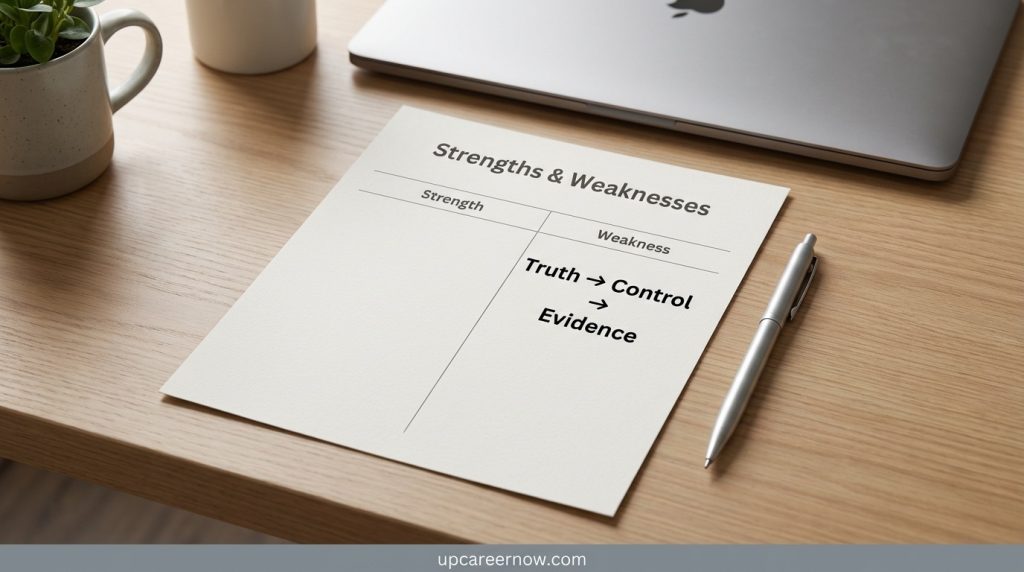
The safest weakness is real, non-fatal, and controllable. Your goal is not to confess. Your goal is to show judgment and improvement.
The “safe weakness” rules
A safe weakness should meet all three:
- Not a core requirement of the job
- Fixable with a system (checklists, time-boxing, feedback, templates)
- Already improving (show how it’s better today)
What weaknesses are usually risky
Avoid weaknesses that directly contradict the job:
- applying for a detail-heavy role: “I miss details”
- applying for a client-facing role: “I struggle with communication”
- applying for a deadline-driven role: “I’m bad with time management”
These can be answered safely only with a very strong “control system” and careful wording. In most cases, choose something safer.
Safer weakness categories (work-style, not character)
- saying yes too quickly (now you clarify scope first)
- over-investing in one task (now you time-box)
- being too independent (now you align earlier)
- presenting too much detail (now you lead with the headline)
- discomfort with public speaking (now you practice and use structure)
The best weakness answer structure
Use: Truth → Control → Evidence
- Truth: state the weakness plainly and professionally
- Control: the system you use to manage it
- Evidence: proof it has improved (even small proof)
This turns the weakness into a signal of maturity, not risk.
Weakness answer formulas that stay safe
For the weakness part of the strengths and weaknesses interview answer, your goal is to show maturity and control. Use the Truth → Control → Evidence structure.
Formula 1: “I used to… now I…”
This keeps it positive and shows improvement.
- Truth: “I used to ___.”
- Control: “Now I ___ (system).”
- Evidence: “It’s improved because ___.”
Example
“I used to say yes too quickly before clarifying scope. Now I ask two quick questions up front—timeline and success criteria—so I don’t create confusion later. It’s improved because my handoffs are clearer and I spend less time reworking expectations.”
Formula 2: “I can over-invest… so I time-box”
Great for detail-focused people, as long as the job isn’t purely speed-based.
Example
“My weakness is that I can over-invest in polishing a task when ‘good enough’ is appropriate. To manage it, I time-box work and confirm priority level early. I’ve improved because I deliver faster while still meeting quality expectations.”
Formula 3: “I prefer working independently… so I align earlier”
Safe for collaborative roles if you show you’ve adjusted.
Example
“I’m naturally independent, which can mean I wait too long before looping others in. Now I align early by sharing a quick outline or status update before I go deep. That’s improved collaboration and reduced surprise changes.”
Formula 4: “Public speaking makes me nervous… so I use structure”
Safe for many roles; less safe for presentation-heavy roles.
Example
“I’m not naturally comfortable with big-group speaking. To manage it, I prepare a short structure and practice the opening and key points. It’s improved because I’m clearer and more confident when presenting updates.”
What to avoid (even if it’s true)
- weaknesses that directly match the job’s hardest requirement
- anything that suggests unreliability (miss deadlines, can’t focus, frequent conflict)
- personal or emotional oversharing
A safe best weakness answer interview is professional, controlled, and improving.
Reply “Next” and I’ll generate the next heading: Examples by job type.
Examples by job type
Below are practical strengths and weaknesses interview examples you can adapt. Each example follows the same safe logic: strength that matches the role + proof, and a weakness that is real but controlled.
1) Administrative / coordinator roles
Safe strength (organization + follow-through)
“One of my strengths is keeping work organized across multiple stakeholders. For example, I maintained a clear tracker, confirmed handoffs early, and followed up on blockers so tasks didn’t get stuck. That matters here because this role depends on reliable coordination.”
Safe weakness (over-commitment → scope questions)
“My weakness is that I used to say yes too quickly before clarifying scope. Now I ask two quick questions up front—timeline and what success looks like—so I don’t create rework later. It’s improved because expectations are clearer and projects move more smoothly.”
2) Customer support / service roles
Safe strength (calm problem-solving)
“My strength is staying calm and structured when resolving issues. I confirm the goal, gather key details, and explain the next step clearly. In my last role, that helped reduce repeat back-and-forth because customers understood what to expect.”
Safe weakness (too much detail → lead with headline)
“My weakness is that I can explain too much detail at once. To control it, I lead with the headline answer first, then offer details if needed. It’s improved because my communication is clearer and faster.”
3) Sales / client-facing roles (non-technical)
Safe strength (relationship building with structure)
“One of my strengths is building trust while staying organized. I keep clear notes on client goals and follow-ups, and I communicate next steps consistently. That matters because clients value reliability as much as results.”
Safe weakness (discomfort with pushy tactics → consultative approach)
“My weakness is that I’m not comfortable with overly aggressive communication. I manage it by using a consultative approach—clarifying needs, summarizing options, and confirming next steps. It’s improved because my conversations feel professional and clients respond well to clarity.”
4) Analyst / reporting roles
Safe strength (structured thinking)
“My strength is turning messy information into a clear story. For example, I’ve built simple summaries that highlight what changed, why it matters, and what the next step should be. That matters here because the team needs decisions, not just data.”
Safe weakness (over-polishing → time-boxing)
“My weakness is that I can over-invest in polishing. To manage it, I time-box analysis and confirm which level of detail is needed. It’s improved because I deliver faster while still being accurate.”
5) Technical / operations roles (process + execution)
Safe strength (process improvement)
“My strength is improving how work flows. I look for repeated friction points, document a better process, and make it easy for others to follow. That matters because small process fixes can prevent recurring errors.”
Safe weakness (too independent → earlier alignment)
“My weakness is that I can be too independent and wait too long to align. Now I share a quick outline early and confirm priorities before I go deep. It’s improved because I avoid last-minute changes.”
Pick the right weakness without creating risk
A smart strengths and weaknesses interview answer avoids one trap: choosing a weakness that makes the interviewer doubt you can do the job. The safest weaknesses are usually work-style friction points—not core competence gaps.
PLACE CHART HERE
Chart guidance
- Where it goes and why: Place the chart here because readers need a quick way to avoid “risky weaknesses” and choose a safe option that still sounds honest.
- Ideal size/aspect ratio: 1200×675 (16:9) with large readable text.
- SEO image title: Strengths and Weaknesses Interview Answer Safe Weakness Picker
- SEO alt text: chart showing safe weakness choices for strengths and weaknesses interview answer
- Nano Banana chart prompt (must include readable “upcareernow.com” under the visual):
Create a clean editorial chart titled “Pick a Safe Weakness (No Red Flags)”. Split into three columns: “Safe choices”, “Sometimes safe (use caution)”, “Avoid for most roles”. Under each, list 5–7 weakness examples. Under each safe weakness, add a short control-system note in smaller text (e.g., “time-boxing”, “checklists”, “early alignment”, “headline-first communication”). High contrast, large readable text, minimal modern style. Add a footer strip beneath with clearly readable “upcareernow.com”. 16:9, crisp, print-ready.
Quick rules to keep it safe
- Don’t pick a weakness that is the job’s main requirement.
- Don’t pick a weakness that implies unreliability (missed deadlines, poor attendance, frequent conflict).
- Do pick something you can control with a real system: time-boxing, checklists, feedback loops, templates.
Safe strength/weakness selector table
Use this to build a strengths and weaknesses interview answer that feels honest and low-risk. Pick one row that matches your role type, then plug it into your answer formula.
Coordination / admin Role type
Pick answers that sound confident, realistic, and coachable.
| Safe strength to choose | Follow-through and stakeholder clarity |
|---|---|
| Safe weakness to choose | Saying yes too quickly |
| Control system to mention | Scope questions + written next steps |
Customer support Role type
Aim for calm + clarity, and show how you prevent issues.
| Safe strength to choose | Calm, structured troubleshooting |
|---|---|
| Safe weakness to choose | Over-explaining details |
| Control system to mention | Headline-first answers + check-in question |
Analyst / reporting Role type
Show decision-making value, not just “nice charts.”
| Safe strength to choose | Turning data into decisions |
|---|---|
| Safe weakness to choose | Over-polishing outputs |
| Control system to mention | Time-boxing + “what level of detail?” upfront |
Operations / process Role type
Balance ownership with alignment so you don’t go solo.
| Safe strength to choose | Process improvement and reliability |
|---|---|
| Safe weakness to choose | Being too independent |
| Control system to mention | Early alignment + quick written outline |
Creative / content Role type
Great weakness = quality-driven, controlled by a system.
| Safe strength to choose | Quality and consistency |
|---|---|
| Safe weakness to choose | Spending too long refining |
| Control system to mention | Deadlines + version checkpoints |
Sales / client-facing Role type
Keep it consultative and process-driven, not “pushy.”
| Safe strength to choose | Relationship building with structure |
|---|---|
| Safe weakness to choose | Discomfort with aggressive tactics |
| Control system to mention | Consultative questions + clear next steps |
Self-score rubric table
Strength clarity Score area
How clearly you explain your chosen strength.
| 0 = Weak | Generic label only |
|---|---|
| 1 = Acceptable | Some explanation |
| 2 = Strong | Clear + role-aligned |
| Quick fix | Add one job-specific phrase |
Strength proof Score area
Do you back up your strength with evidence?
| 0 = Weak | No example |
|---|---|
| 1 = Acceptable | Vague example |
| 2 = Strong | Concrete action + outcome |
| Quick fix | Add one result or scope cue |
Weakness safety Score area
How risky your chosen weakness sounds.
| 0 = Weak | Core job risk |
|---|---|
| 1 = Acceptable | Borderline risky |
| 2 = Strong | Non-core + controlled |
| Quick fix | Shift to work-style weakness |
Control system Score area
How you show improvement and self-management.
| 0 = Weak | No improvement plan |
|---|---|
| 1 = Acceptable | Basic explanation |
| 2 = Strong | Clear system (checklist, time-box, alignment) |
| Quick fix | State your process explicitly |
Length & tone Score area
How polished and interview-friendly your answer sounds.
| 0 = Weak | Too long or defensive |
|---|---|
| 1 = Acceptable | Slightly long |
| 2 = Strong | Confident + concise |
| Quick fix | Cut background, keep structure |
Common mistakes and quick fixes
These mistakes can make a good candidate sound risky. Fixing them usually takes one edit.
Mistake 1: Choosing a weakness that’s actually a job requirement
Example: applying for a deadline-heavy role and saying “time management.”
Quick fix: Choose a work-style weakness that doesn’t threaten the core tasks (e.g., “I can over-polish, so I time-box”).
Mistake 2: Saying a strength with no evidence
“I’m detail-oriented” without proof sounds empty.
Quick fix: Add a single proof line:
“I use a checklist and confirm requirements early to prevent rework.”
Mistake 3: Sounding like you’re bragging
If your strength sounds inflated, the interviewer may feel resistance.
Quick fix: Shift from labels to behaviors:
“I keep stakeholders aligned with clear updates and next steps.”
Mistake 4: Over-sharing personal weaknesses
Interviews are not therapy sessions.
Quick fix: Keep weakness professional and job-related, then show control.
Mistake 5: “My weakness is I work too hard”
Interviewers hear this as avoidance.
Quick fix: Use a real weakness that is controllable and improving.
Mistake 6: No improvement system
A weakness without a plan sounds like a permanent problem.
Quick fix: Add your control system in one sentence:
“Now I time-box, prioritize, and confirm what ‘good enough’ looks like.”
FAQs
1) What is the safest strengths and weaknesses interview answer?
The safest strengths and weaknesses interview answer picks a role-aligned strength with one proof example, and a weakness that is not a core job requirement—then explains a clear system you use to improve it.
2) How do I choose strengths and weaknesses interview examples that won’t backfire?
Choose strengths that match the job description and weaknesses that are work-style issues you can control (time-boxing, checklists, early alignment). Avoid weaknesses that suggest unreliability.
3) How do I answer the strengths and weaknesses interview question if I don’t have big achievements?
Use scope cues instead of big numbers: frequency (weekly), volume (high-volume), stakeholders (cross-team), and complexity (multi-step). Proof matters more than size.
4) What is a good best weakness answer interview that sounds honest?
A good best weakness answer interview is: “I can ___ (truth), so I ___ (control system). It’s improved because ___ (evidence).” Keep it professional and role-safe.
5) Should my weakness be related to the job?
Only indirectly. A weakness should not undermine the job’s core requirements. Pick a weakness that shows self-awareness but doesn’t create doubt about your ability to perform.
6) How long should my strengths and weaknesses interview answer be?
Aim for 45–75 seconds total: about 20–35 seconds on strength (with proof) and 25–40 seconds on weakness (truth + control + evidence).
7) Can I use the same strengths and weaknesses interview answer for every job?
Use the same structure, but tailor the strength and proof story to each role’s priorities. Small changes make it sound specific and credible.
Limitations and Disclaimer
“Career information on UpCareerNow is provided for general guidance and planning purposes only. Actual outcomes depend on skills, experience, location, and market conditions.”
Ad & Content Safety Note
This article is written to be practical and AdSense-safe. It avoids guarantees and encourages honest, defensible interview answers that don’t create unnecessary risk. Interview expectations vary by role and industry, so tailor your examples to the job description.
REFERENCES
Work Experience Section: Bullet Formulas That Work

Tell Me About Yourself Interview Answer (Best Answer Templates)
Resume Keywords: How to Match Job Descriptions Safely
About The Author
