
Tell Me About Yourself Interview Answer (Best Answer Templates)
The tell me about yourself interview answer is usually the first moment an interviewer decides whether your communication will be easy to follow. They are not asking for your full background. They want a short, job-relevant summary: what you do (or are moving toward), one proof point that shows you can do it, and why this role makes sense next. A strong tell me about yourself interview answer also helps you control the interview, because it naturally leads into the interviewer’s next questions about your skills and examples.
In this guide, you’ll get practical templates by career stage, a quick selector chart to choose the right version, and a rubric to tighten your answer in one practice run—without sounding rehearsed.
Must Read: Complete interview preparation guide →
What interviewers mean by “tell me about yourself”
When an interviewer asks this question, they’re usually evaluating four things quickly:
1) Can you summarize your role identity?
They want to understand what lane you’re in: the work you do today, or the work you’re targeting. This helps them decide which follow-up questions to ask and what level of detail to expect.
2) Are you relevant to the job in front of them?
A good tell me about yourself interview answer signals you read the job description and can connect your background to their priorities. You don’t need perfect alignment—just credible overlap.
3) Do you use proof, not just adjectives?
Words like “hardworking” and “passionate” don’t help the interviewer predict performance. One short example does. Even if you don’t have big numbers, you can show scope: frequency (weekly), volume (high-volume), stakeholders (cross-team), or complexity (multi-step).
4) Do you have direction?
They’re also checking whether your next step makes sense. If you sound unclear about what you want, they may worry you’ll be hard to place or won’t stay engaged.
Recommended length: Aim for 60–90 seconds in most interviews, and 30–60 seconds for a phone screen. The goal is to be complete, not long.
Must Read: Most common interview questions and best answers →
The 3-part structure that works in most interviews

If you only learn one structure for your tell me about yourself interview answer, make it this:
Part 1: NOW (who you are today)
Start with your current role or your target role identity.
- “I’m currently a ___ focused on ___.”
- “I’m transitioning into ___ with a focus on ___.”
This opening should be clear enough that the interviewer can categorize you instantly.
Part 2: PROOF (one relevant highlight)
Pick one proof point that maps to the job.
Keep it tight:
- 1 sentence for what you did
- 1 sentence for what happened because you did it
If you don’t have measurable results, use scope cues:
- “I supported a high-volume workflow…”
- “I coordinated across multiple stakeholders…”
- “I standardized a process to reduce mistakes…”
Part 3: NEXT (why this role makes sense)
End with direction and fit.
- “I’m now looking for ___, and this role stood out because ___.”
- “I’m excited about this role because it would let me ___.”
This is the moment your answer becomes role-specific. It’s also the easiest place to improve if your answer feels generic.
A practical timing rule
- 30–45 seconds: phone screen version
- 60–90 seconds: standard version
If you go longer, you’ll usually lose focus and sound less confident.
A copy-paste tell me about yourself answer template
Below are three templates you can paste into your notes and customize. Use bullet notes, not a memorized script. The structure keeps you clear; your wording can stay natural.
Template 1: The “clean universal” version (Now → Proof → Next)
This is the most reliable tell me about yourself answer template across roles.
- NOW: “I’m currently ___ (role/direction), focused on ___ (theme).”
- PROOF: “Recently, I ___ (action) which helped ___ (outcome/scope).”
- NEXT: “I’m now looking to ___, and this role stood out because ___.”
Example (outline):
“I’m currently a project coordinator focused on smooth handoffs and reliable follow-through. Recently, I standardized weekly updates across stakeholders so tasks didn’t slip. I’m now looking for a role where I can support execution at a larger scale, and this position fits because coordination is a core priority.”
Template 2: The “capability” version (Role → Strength → Proof → Fit)
Use this when the interviewer wants to know what you’re good at quickly.
- “I’m a ___ who’s strongest at ___.”
- “For example, I ___ (proof).”
- “That matters here because ___ (role priority).”
Template 3: The “career change” version (Transferable strength → Proof → Why change → Fit)
Use this when your background isn’t an obvious match.
- “I’ve been working in ___, where I built strengths in ___.”
- “A relevant example is ___ (transferable proof).”
- “I’m transitioning into ___ because ___.”
- “This role fits because ___.”
Key rule: Don’t over-explain the change. Keep it calm and forward-looking.
Templates by career stage
A strong tell me about yourself interview answer changes slightly based on where you are in your career. The structure stays the same; the proof and emphasis change.
Early-career / student / fresh graduate
Your goal is to sound capable and job-relevant, even if your proof comes from projects instead of full-time roles.
Best structure: Now → Proof (project) → Next
What to emphasize: skills you practiced, how you worked, and what improved because of your work.
Template
- NOW: “I’m a recent ___ graduate / early-career ___ focused on ___.”
- PROOF: “In a recent project/internship, I ___ (action) to ___ (outcome/scope).”
- NEXT: “I’m looking for a role where I can ___, and this role fits because ___.”
Tell me about yourself interview example (outline)
“I’m a recent graduate focused on coordination and clear communication. In my internship, I tracked weekly updates across stakeholders and standardized handoffs so tasks didn’t slip. I’m now looking for a role where I can support reliable execution, and this role stood out because coordination is a core priority.”
Mid-level professional
Here, the interviewer wants to hear ownership, scope, and repeatable impact. Your tell me about yourself interview answer should signal you’re steady and reliable, not just “busy.”
Best structure: Now → Proof (ownership) → Next
What to emphasize: what you owned, who you worked with, and what improved.
Template
- NOW: “I’m a ___ with a focus on ___.”
- PROOF: “Recently, I owned/led ___ by ___, which helped ___.”
- NEXT: “I’m now looking to ___, and this role makes sense because ___.”
Career change
The goal is to make the transition feel logical. You don’t need to defend the change. You need to show transferable proof and a clear direction.
Best structure: Transferable strengths → Proof → Why change → Fit
What to emphasize: transferable work (communication, analysis, coordination, documentation, process).
Template
- “I’ve been working in ___, where I built strengths in ___.”
- “For example, I ___ (transferable proof).”
- “I’m moving into ___ because ___.”
- “This role fits because ___.”
Common mistake: explaining the old field too much. Keep it tight and forward-looking.
Returning after a gap
Keep the gap explanation short and move quickly to relevance and readiness. A good tell me about yourself interview answer here sounds calm and professional.
Best structure: Now (returning) → Proof (from before) → Next (ready)
Template
- NOW: “I’m returning to work and focused on roles in ___.”
- PROOF: “Previously, I ___ (relevant proof).”
- NEXT: “I’m ready to contribute in ___, and this role fits because ___.”
Senior / lead roles
Senior answers should show judgment, prioritization, and leadership influence—not a long list of responsibilities.
Best structure: Now (scope) → Proof (decision + impact) → Next (bigger scope fit)
Template
- NOW: “I lead/own ___ with a focus on ___.”
- PROOF: “Recently, I made a decision to ___ and executed ___, which resulted in ___.”
- NEXT: “I’m looking to drive ___ at a larger scope, and this role fits because ___.”
Templates by interview format
The best tell me about yourself interview answer also changes slightly based on the format. The structure stays consistent, but the length and detail shift.
Phone screen (30–60 seconds)
The phone screen version should feel like a clean headline plus one proof point.
What to do
- 1 sentence NOW
- 1 sentence PROOF
- 1 sentence NEXT
Then stop.
Mini template
“I’m currently ___ focused on ___. Recently I ___ which helped ___. I’m looking for ___, and this role stood out because ___.”
Why it works: phone screens reward clarity and speed. If you talk too long, you can sound unfocused.
Hiring manager round (60–90 seconds)
This is the most common setting for a full tell me about yourself interview answer.
What to do
- give slightly more context for the proof highlight
- keep the result/outcome visible
- use role language naturally (one or two priority phrases)
Simple upgrade
Add one scope cue to the proof:
- “weekly,” “cross-team,” “high volume,” “multiple stakeholders,” “tight deadlines”
Panel interview (60–90 seconds, but more “shareable” proof)
A panel includes people with different priorities. Your proof highlight should be understandable to everyone.
What to do
- choose a proof example that touches communication + execution
- avoid niche technical detail
- make the outcome easy to understand
Panel-friendly proof phrasing
“I coordinated across stakeholders and kept the work moving by standardizing updates and removing blockers early.”
Final round (value + fit, not biography)
Late-stage interviews often focus on confidence, judgment, and alignment.
What to do
- keep the structure
- choose a proof highlight that signals judgment or prioritization
- end with a fit statement that’s specific, not flattering
Fit statement examples
- “This role fits because it needs someone who can keep cross-team work reliable.”
- “This matches the kind of scope where I do my best work—clear priorities, strong stakeholders, measurable outcomes.”
Choose the right version fast
When people struggle with the tell me about yourself interview answer, it’s often because they pick the wrong version—too long for a phone screen, too detailed for a panel, or too generic for a hiring manager.
Use this selector once, and your practice becomes easier.
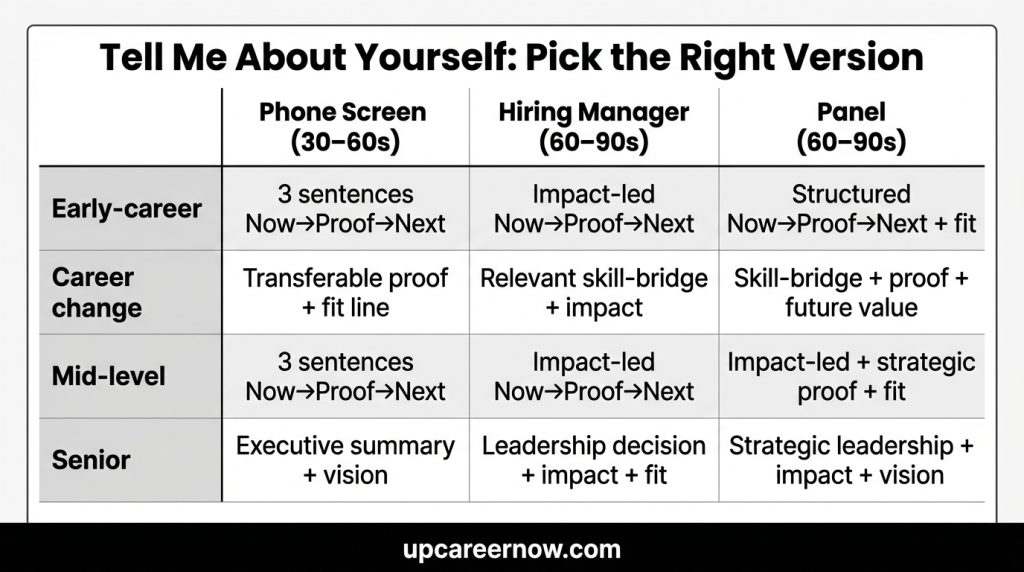
Template selector table
This table is a practical bridge between “frameworks” and real preparation. Use it to pick your tell me about yourself answer template quickly, then write bullet notes under each line.
| Your situation | Best structure | What to emphasize | One-line reminder |
|---|---|---|---|
| Phone screen (fast pace) | 3-sentence Now → Proof → Next | Clarity, direction | Answer, prove, align—then stop. |
| Early-career / limited experience | Project-led Now → Proof → Next | Projects, internships, transferable skills | One good project beats three vague claims. |
| Career change | Transferable proof + clean “why now” | Transferable action, motivation, fit | Keep the change calm and forward-looking. |
| Mid-level | Impact-led Now → Proof → Next | Ownership, scope, outcome | Show what you owned and what improved. |
| Senior / lead roles | Leadership decision → impact → fit | Judgment, prioritization, stakeholder alignment | Show how you think, not just what you did. |
| Panel interview | Scope-forward, cross-team proof | Communication + execution | Choose proof everyone can understand. |
Self-score rubric table
Use this after one practice run. It’s a fast way to tighten your tell me about yourself interview answer without rewriting everything.
| Score area | 0 = Needs work | 1 = Okay | 2 = Strong | Quick fix |
|---|---|---|---|---|
| First sentence clarity | Unclear role direction | Somewhat clear | Clear role identity + theme | Rewrite the first line as “I’m currently ___ focused on ___.” |
| Proof highlight | No example | Example is vague | Concrete action + outcome | Add one action and one outcome (or scope cue). |
| Role alignment | No link to job | General link | Direct link to role priorities | Use one priority phrase from the job description. |
| Length control | 2+ minutes | 90–120 seconds | 60–90 seconds | Cut history to one sentence; keep one proof story only. |
| Natural delivery | Sounds memorized | Mostly natural | Conversational + confident | Switch from full sentences to bullet notes. |
Common mistakes and quick repairs
Even strong candidates weaken their tell me about yourself interview answer with a few predictable mistakes. Here are the most common ones and practical fixes.
Mistake 1: Starting with a full timeline
If you begin with “I started my career in…” you’re forcing the interviewer to wait for relevance.
Quick repair: Start with NOW. Keep history only if it directly supports the role.
Mistake 2: Listing tasks instead of proof
Tasks describe what a job is. Proof shows what you can do.
Quick repair: Convert one task into one impact line:
- Task: “I handled customer requests.”
- Proof: “I handled high-volume customer requests and reduced repeat issues by standardizing responses.”
Mistake 3: Using generic adjectives
“Hardworking” and “motivated” don’t predict performance without evidence.
Quick repair: Replace adjectives with behavior:
- “detail-oriented” → “I use checklists and confirm requirements early to prevent rework.”
Mistake 4: Missing the “NEXT” line
If you don’t state direction, the interviewer can’t easily map you to the role.
Quick repair: Add one clean sentence:
“I’m now looking for ___, and this role fits because ___.”
Mistake 5: Trying to fit multiple stories
Multiple examples often create a scattered answer.
Quick repair: Choose one best proof highlight and keep the rest for later questions.
Mistake 6: Oversharing negatives
Explaining conflict, frustration, or dissatisfaction early can distract from your strengths.
Quick repair: Keep it neutral and future-focused:
“I’m looking for roles with more ___ (scope, ownership, learning).”
Author bio
UpCareerNow Editorial & Research Team
We publish practical, calm career guidance focused on clarity, proof-based communication, and interview readiness. This article helps you build a strong tell me about yourself interview answer using adaptable templates, role-aligned proof, and simple practice methods that keep you concise without sounding scripted.
FAQs
1) What is the best tell me about yourself interview answer?
The best tell me about yourself interview answer is a short Now → Proof → Next summary: who you are today, one relevant proof highlight, and why this role makes sense next.
2) How long should a tell me about yourself interview answer be?
A tell me about yourself interview answer is usually strongest at 60–90 seconds, with a shorter 30–60 second version for phone screens.
3) What is a good tell me about yourself answer template I can reuse?
A solid tell me about yourself answer template is: “I’m currently ___; recently I ___ (proof); and I’m now looking to ___ because ___.”
4) How do I learn how to answer tell me about yourself without sounding rehearsed?
Use bullet notes and practice the structure out loud. Keep the proof highlight consistent and vary your wording naturally so it sounds conversational.
5) Can you share a tell me about yourself interview example for career changers?
Yes: lead with transferable strengths from your previous field, give one transferable proof example, then add a calm “why now” and a role-aligned fit line.
6) What should I avoid in a tell me about yourself best answer?
Avoid long biographies, negative explanations about past roles, and lists of skills without a real example that supports them.
7) What if I have no experience—can I still give a strong answer?
Yes. Use projects, internships, volunteering, or coursework as proof and add scope cues like frequency, stakeholders, or complexity.
Limitations and Disclaimer
“Career information on UpCareerNow is provided for general guidance and planning purposes only. Actual outcomes depend on skills, experience, location, and market conditions.”
Ad & Content Safety Note
This content is written to be practical and AdSense-safe. It avoids guarantees and encourages honest, defensible interview answers. Interview formats vary across roles, so use these templates as a baseline and tailor your proof and fit lines to each job.
REFERENCES
- U.S. Department of Labor — CareerOneStop: Interviewing
- National Association of Colleges and Employers (NACE): Interviewing guidance
- U.S. Equal Employment Opportunity Commission (EEOC): Interview/job-related fairness context
Resume Writing Guide (ATS-Friendly + Human-Friendly)
Resume Keywords: How to Match Job Descriptions Safely
Strengths and Weaknesses Interview Answer (Safe Examples)
About The Author
