
our work experience section is the most important part of your resume because it turns claims into proof. Recruiters don’t hire keyword lists—they hire evidence. The fastest way to improve a resume is usually not changing the design or adding more skills. It’s rewriting weak bullets into clear, outcome-focused statements that show what you did, how you did it, and why it mattered.
This guide gives you simple resume bullet formulas you can reuse across roles, plus examples for different situations (with and without metrics). You’ll also get a decision table and checklist you can apply in minutes.
Read full Resume Writing Guide (ATS-Friendly + Human-Friendly) at resume writing guide.
What the Work Experience Section Must Prove
A strong work experience section answers four questions quickly:
- What did you own?
Your responsibility area and role level. - What changed because of your work?
Speed, quality, customer outcomes, delivery reliability, cost, risk, or consistency. - How did you do it?
The method, process, tools, and collaboration. - How big was it?
Scope signals: volume, frequency, stakeholders, complexity, or timelines.
The “task vs proof” difference
Task-only bullets describe activity:
- “Responsible for reporting.”
- “Helped with documentation.”
- “Handled customer issues.”
Proof bullets show impact:
- “Improved weekly reporting accuracy by standardizing inputs and adding validation checks.”
- “Reduced onboarding confusion by updating documentation and creating a simple checklist used by new hires.”
Why this matters for ATS and humans
- ATS can search keywords, but recruiters evaluate credibility.
- The best resumes combine resume keywords with evidence inside bullets.
If you want the overall structure that supports this section (format + placements), use the hub:
https://upcareernow.com/resume-writing-guide/
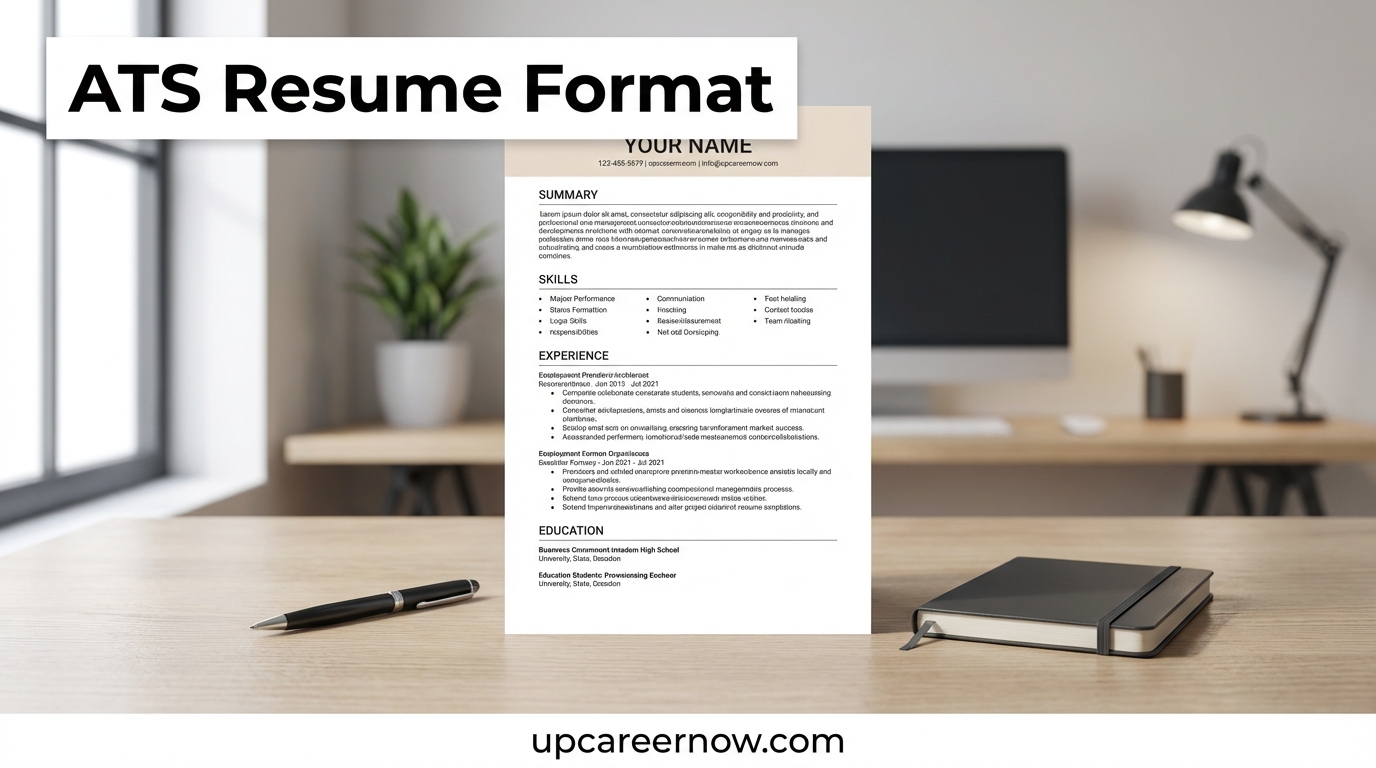
Best Work Experience Section Structure
A reliable resume work experience section is easy to scan and easy to parse. It uses a repeatable job-entry layout and keeps bullets consistent.
The safest structure (copy-ready)
For each role, use:
Job Title — Company | Location | Dates
One-line context (optional): team, scope, or purpose.
- Bullet 1 (proof-first)
- Bullet 2 (proof-first)
- Bullet 3 (proof-first)
How many bullets per role?
A practical guideline:
- Most recent role: 3–6 bullets
- Previous role(s): 2–4 bullets
- Older roles: 1–2 bullets or a short summary line
This keeps your resume focused and avoids overload.
What makes a bullet “proof-first”
A proof-first bullet includes:
- an outcome (what improved/changed)
- the action (what you did)
- the method/tools (how you did it)
- a scope cue (volume, frequency, stakeholders)
The consistency rule
Keep these consistent across roles:
- bullet style
- tense (past for past roles, present for current role)
- date formatting
- spacing
This consistency improves readability and supports an ATS-friendly layout.
Also Read: Resume mistakes that reduce interview calls
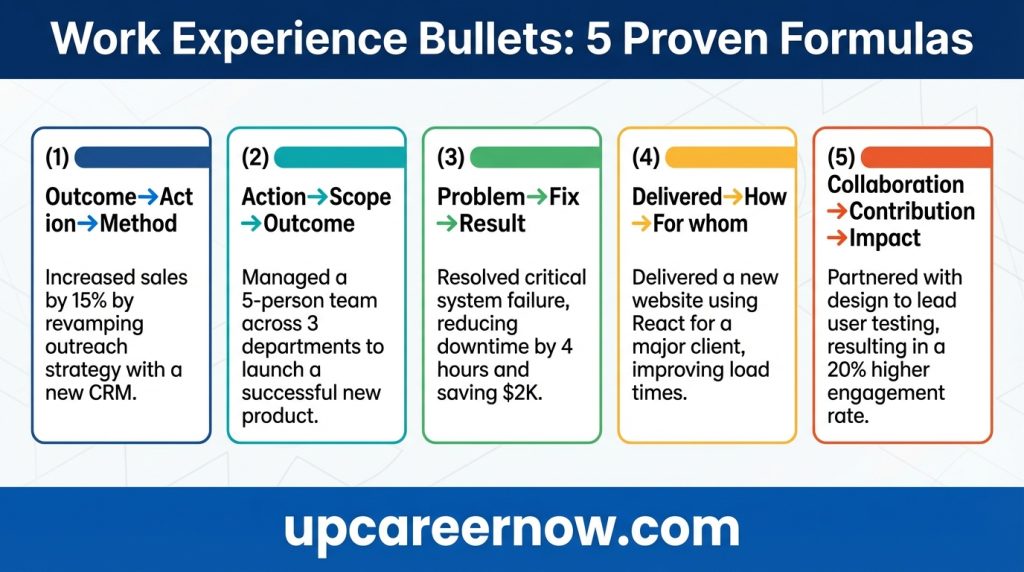
The 5 Bullet Formulas That Work
These resume bullet formulas are simple on purpose. They help you write strong work experience bullet points even when you don’t have perfect metrics.
Formula 1: Outcome → Action → Method
Use when: you can name a result (even qualitative).
Template:
- Improved ___ by ___ using ___.
Example:
- Improved reporting accuracy by standardizing inputs and adding a simple validation step.
Formula 2: Action → Scope → Outcome
Use when: your scope is clear (volume, frequency, complexity).
Template:
- Managed/led/built ___ across ___, resulting in ___.
Example:
- Coordinated weekly stakeholder updates across two teams, resulting in fewer last-minute priority changes.
Formula 3: Problem → Fix → Result
Use when: you solved a recurring issue.
Template:
- Identified ___, fixed it by ___, which led to ___.
Example:
- Identified frequent rework caused by unclear intake, fixed it by creating a checklist, which reduced back-and-forth.
Formula 4: Delivered → How → For whom
Use when: you shipped a deliverable (reports, documentation, workflows).
Template:
- Delivered ___ by ___ for ___ (stakeholders/users).
Example:
- Delivered a simplified onboarding guide by rewriting key steps for new hires and team leads.
Formula 5: Collaboration → Contribution → Impact
Use when: you worked cross-functionally and need to show your role clearly.
Template:
- Partnered with ___ to ___; contributed by ___; impact: ___.
Example:
- Partnered with support and ops to standardize escalation steps; contributed documentation and training notes; impact: smoother handoffs.
These formulas keep bullets structured, readable, and defensible.
Work Experience Bullet Points (Examples You Can Adapt)
Use these work experience section examples as patterns. Swap in your real work, tools, and scope. Keep them short and proof-first.
Operations / Coordination examples
- Improved weekly reporting accuracy by standardizing inputs and adding a simple validation step before submission.
- Coordinated cross-team priorities by tracking open items weekly and aligning stakeholders on timelines and ownership.
- Reduced avoidable rework by creating an intake checklist and clarifying required details for requests.
Customer-facing / Support examples
- Resolved customer issues by following structured troubleshooting steps and documenting repeat solutions for faster handling.
- Reduced repeat questions by updating help documentation and using clearer response templates for common cases.
- Supported escalations by capturing key context, coordinating handoffs, and tracking outcomes to closure.
Admin / Documentation / Process examples
- Improved documentation clarity by rewriting key workflows into step-by-step instructions used during onboarding.
- Streamlined routine tasks by combining duplicated steps and creating a simple tracking sheet to reduce missed follow-ups.
- Increased consistency by standardizing file naming and documentation templates across the team.
If you’re early-career (projects/internships)
- Delivered a project report by collecting inputs, organizing findings, and presenting a clear summary for review.
- Built a simple workflow checklist that reduced confusion and improved consistency for repeat tasks.
- Supported a team process by documenting steps and creating a small reference guide for new contributors.
If your bullets still feel “task-only,” the next section shows how to add metrics and scope without guessing.
How to Add Metrics Without Guessing
You don’t need big numbers to write credible bullets. The goal is to add specificity without inventing facts. In a strong work experience section, metrics can be quantitative or “scope-based.”
Safe types of measurable detail
Use what you can truthfully support:
1) Frequency
- daily, weekly, monthly, end-of-quarter
Example: “Created weekly updates for stakeholders…”
2) Volume
- number of requests, tickets, reports, users, files
Example: “Handled high-volume requests during…”
3) Time
- turnaround time, response time, cycle time
Example: “Reduced turnaround time by…”
4) Quality
- fewer errors, fewer escalations, fewer revisions
Example: “Improved accuracy by adding…”
5) Stakeholder scope
- cross-team, multi-stakeholder, internal/external
Example: “Coordinated with two teams…”
“Good enough” scope signals (when numbers aren’t available)
If you can’t quantify precisely, use scope cues:
- “high-volume,” “time-sensitive,” “cross-functional,” “recurring,” “multi-step,” “complex cases”
This is still better than vague claims.
What not to do
Avoid:
- guessing percentages or dollar values
- using inflated numbers you can’t explain
- adding metrics that sound impressive but don’t match your role
Your bullets should stay interview-safe. If you can explain the metric and how you influenced it, it belongs.
Fixing Weak Bullets (Before → After)
If your resume work experience section feels generic, this is usually why: the bullets describe tasks but don’t show outcomes, methods, or scope. Here are common “before” lines and how to rewrite them using the formulas.
Example 1
Before: Responsible for reporting.
After: Improved weekly reporting accuracy by standardizing inputs and adding a simple validation step before submission.
Example 2
Before: Helped with documentation.
After: Improved documentation clarity by rewriting key workflows into step-by-step instructions used during onboarding.
Example 3
Before: Worked with different teams.
After: Coordinated cross-team priorities by tracking open items weekly and aligning stakeholders on timelines and ownership.
Example 4
Before: Handled customer issues.
After: Resolved customer issues by following structured troubleshooting steps and documenting repeat solutions for faster handling.
Example 5
Before: Assisted with process improvement.
After: Reduced avoidable rework by identifying missing intake details and creating a checklist that clarified required information.
What changed in the “after” versions
Each improved bullet includes at least two of the following:
- an outcome
- a method/action
- a scope cue (weekly, cross-team, onboarding, repeat solutions)
You don’t need to make every bullet “big.” You just need to make it clear and believable.
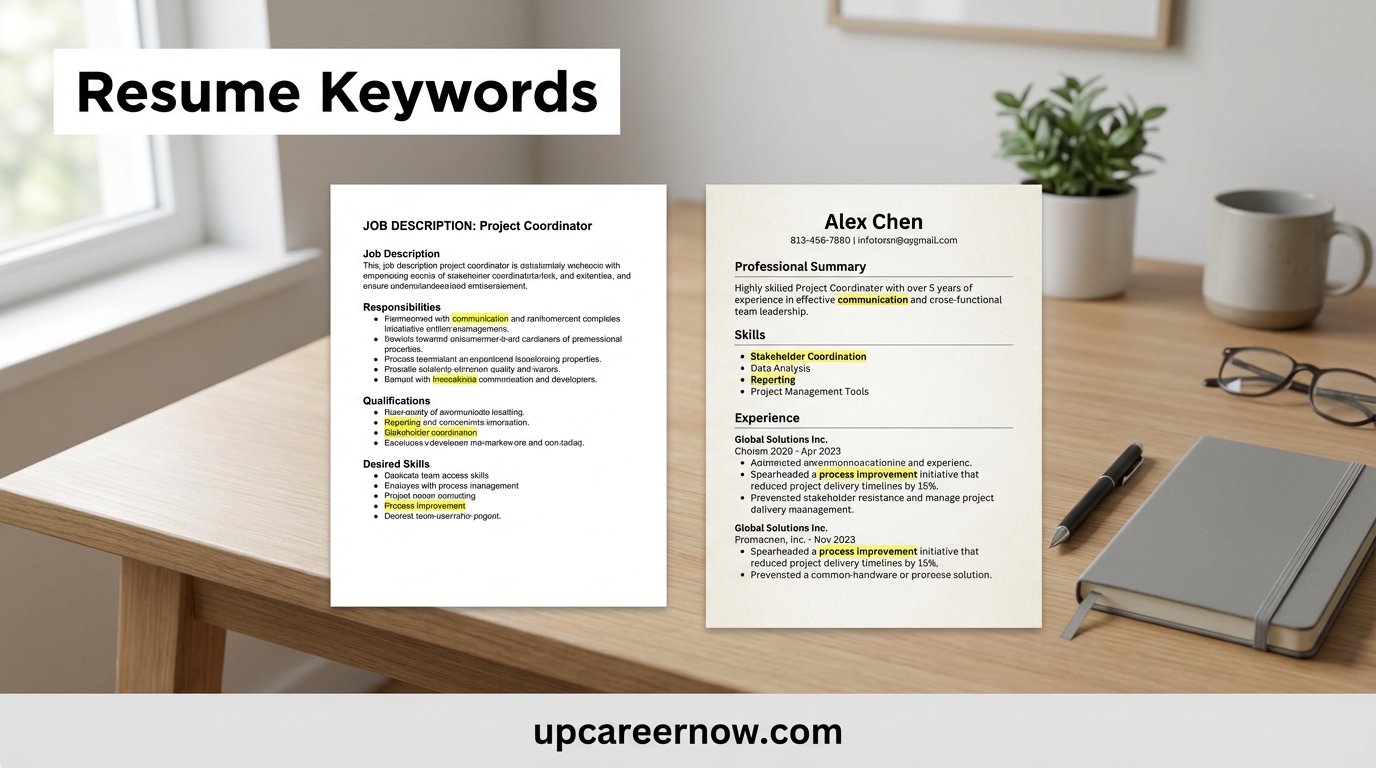
Align Bullets With Resume Keywords
The best bullets do two jobs at once:
- they prove impact, and
- they include relevant resume keywords naturally.
This is how you align your work experience section with the job description without stuffing.
Step 1: Pick 8–14 core keywords (from the posting)
Use the same shortlist method from the keywords guide:
- role responsibilities
- methods/processes
- tools/systems (only if true)
- outcomes and success signals
Step 2: Match keywords to bullets (not the other way around)
Don’t write a bullet to “fit a keyword.” Instead:
- find bullets that already relate to those keywords
- rewrite them slightly so the keyword labels the work clearly
Example (natural keyword placement)
If the job uses “stakeholder coordination,” don’t paste it everywhere. Use it where it’s true:
- “Coordinated stakeholder updates weekly to align timelines and ownership.”
Step 3: Use the proof rule
If a keyword appears in Skills, it should appear in at least one bullet or project line as proof.
Cross-link to your supporting article
For a full step-by-step keyword method, link readers to:
Resume Keywords: Match Job Descriptions Safely → https://upcareernow.com/resume-keywords-match-job-description/
Quick 15-Minute Rewrite Workflow
Use this workflow to upgrade your work experience section quickly without rewriting your whole resume.
Minute 1–3: Choose the role you’re targeting
Pick one job posting and list the top:
- 8–14 core keywords
- 2–3 outcomes they care about (speed, quality, delivery, customer impact)
Minute 4–8: Rewrite your top 3 bullets (most recent role)
Use these steps:
- replace “responsible for” with an action + outcome
- add one scope cue (weekly, cross-team, high-volume, onboarding)
- include one relevant keyword only where it fits naturally
Minute 9–12: Fix your weakest bullets across roles
Look for bullets that are:
- task-only
- vague (“helped,” “assisted,” “worked on”)
Rewrite 2–3 of them using Formula 1–3.
Minute 13–15: Proof + skim test
- skim your experience section in 20 seconds
- confirm each role has at least 2 proof bullets
- make sure your best proof is in the top half of the resume
This keeps your effort focused and makes the biggest difference quickly.
Decision Inputs & Outcomes
| What you have | Best bullet formula | What to include | Likely outcome | Risk to watch |
|---|---|---|---|---|
| Clear results | Outcome → Action → Method | Result + what you did + how | High credibility and fast scanning | Over-claiming the result |
| Strong scope | Action → Scope → Outcome | Volume/frequency/stakeholders + outcome | Better role clarity and impact | Scope without outcomes feels flat |
| Problems solved | Problem → Fix → Result | Issue + solution + improvement | Shows judgment and initiative | Too much story, not enough result |
| Deliverables | Delivered → How → For whom | Output + method + audience | Clear proof of tangible work | Deliverable listed without benefit |
| Cross-team work | Collaboration → Contribution → Impact | Partners + your part + impact | Clarifies your role in teamwork | Sounds like a group effort with no ownership |
| No hard numbers | Add scope signals | Frequency, volume cues, complexity | More specificity without guessing | Vague words without context |
Work Experience Section Checklist Table
| Area | Do this | Avoid this | Quick self-test |
|---|---|---|---|
| Role entries | Title — Company | Location | Dates | Dates separated from roles | Can you scan each role in 2 seconds? |
| Bullet quality | Outcome-first + method + scope | Task-only bullets | Does each bullet answer “so what”? |
| Bullet length | 1–2 lines (most of the time) | Paragraph bullets | Can a recruiter skim in 20 seconds? |
| Metrics | Use real numbers or scope signals | Guessing percentages | Could you explain the number in an interview? |
| Keywords | Use keywords where proof exists | Stuffing keywords everywhere | Are keywords supported by bullets? |
| Consistency | Same style across roles | Mixed tense/formatting | Does the section look uniform down the page? |
Author Bio
Author: UpCareerNow Editorial & Research Team
Role: Editorial team specializing in resume strategy, ATS-safe writing, and hiring-aligned career guidance.
Bio: The UpCareerNow Editorial & Research Team publishes practical resources that help readers present work clearly and accurately. This article focuses on building a stronger work experience section using repeatable bullet formulas, safe ways to add scope, and proof-first writing that stays credible in interviews.
FAQs
1) What should a work experience section include?
A strong work experience section includes consistent role entries (title, company, dates, location) plus bullets that show outcomes, methods, and scope—so the reader sees proof, not just tasks.
2) How many bullets should I include per job?
In a typical resume work experience section, use 3–6 bullets for your most recent role, 2–4 for previous roles, and fewer for older roles to keep the resume skimmable.
3) What are the best work experience bullet points?
The best work experience bullet points are proof-first: they describe what improved, what you did, and how you did it. If you can add a metric or scope cue, it becomes even clearer.
4) What if I don’t have numbers or metrics?
Use scope signals like frequency (weekly), volume (high-volume), complexity, stakeholders, or quality outcomes (fewer errors). Avoid guessing percentages.
5) How do I rewrite “responsible for” bullets?
Replace “responsible for” with an action and an outcome. Example: “Improved ___ by ___ using ___.” This turns tasks into evidence.
6) Should I match my work experience section to the job description?
Yes, but safely. Use relevant resume keywords where they fit naturally and where your bullets provide proof—avoid stuffing terms you can’t defend.
7) What’s the fastest way to improve my work experience section?
Rewrite your top 3 bullets in your most recent role using a bullet formula (outcome + method + scope), then fix 2–3 weak bullets elsewhere.
Limitations and Disclaimer
“Career information on UpCareerNow is provided for general guidance and planning purposes only. Actual outcomes depend on skills, experience, location, and market conditions.”
Ad & Content Safety Note
This article is written to be practical and AdSense-safe. It avoids guarantees and encourages honest, defensible resume writing. Use these bullet formulas as a structure for clarity, then tailor them to your real responsibilities and outcomes.
REFERENCES (2–4 authoritative sources max)
- National Association of Colleges and Employers (NACE) — What employers look for when reviewing resumes.
https://www.naceweb.org/talent-acquisition/candidate-selection/what-are-employers-looking-for-when-reviewing-college-students-resumes - U.S. Bureau of Labor Statistics (BLS) — Occupational Outlook Handbook (role requirements and hiring context).
https://www.bls.gov/ooh/