
A skill development roadmap is a practical system for choosing the right skill, learning it efficiently, and proving it with real evidence of ability. It replaces random learning with a clear sequence: select → learn → practice → prove → improve.
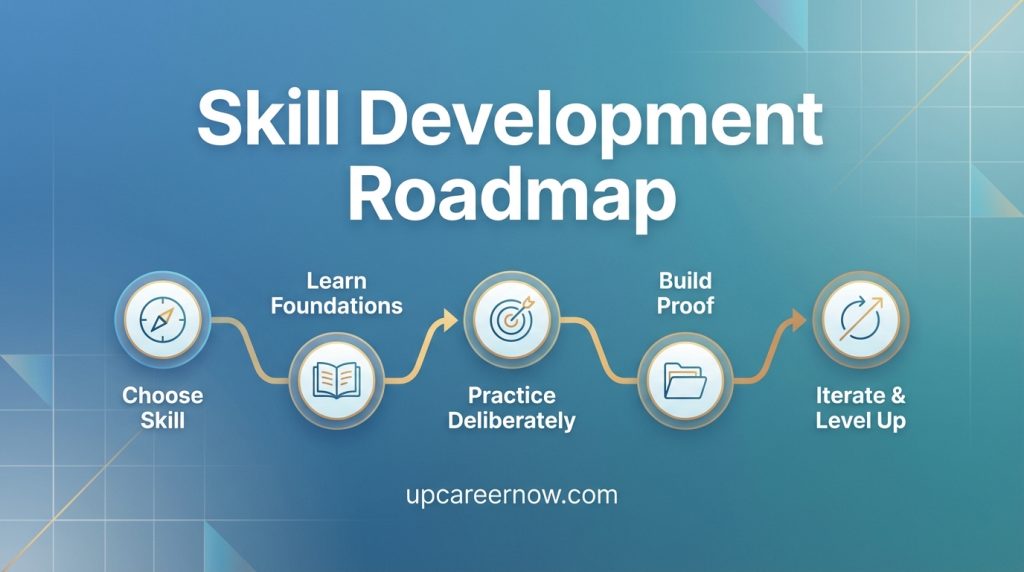
Skill development roadmap
Most people fail at skill-building not because they lack motivation, but because they do not define what “job-ready” looks like, how they will practice, or what proof they will show when opportunities appear.
This guide gives you a complete skill development roadmap for career growth. It shows you how to:
- choose a skill with real value
- learn skills faster without wasting time
- practice in a way that actually improves performance
- build proof of work employers can trust
- turn effort into a portfolio, career signal, and real opportunity
If you want one sentence to guide the whole article, use this:
Your skill development roadmap should produce proof every week, not just learning.
Quick answer: What is a skill development roadmap?
A skill development roadmap is a structured plan that helps you:
- choose the right skill
- break it into sub-skills
- practice deliberately
- measure progress
- build proof of competence
- become job-ready faster
It takes you from:
“I want to learn this”
to
“I can prove I can do this.”
That is what makes a roadmap useful. It does not just organize learning. It turns learning into visible career progress.
Why most skill development plans fail
A lot of people stay busy but never become marketable.
That happens because most skill plans fail for predictable reasons.
1) They confuse learning with progress
Watching videos, reading guides, and saving resources feels productive. But it is not proof. Real progress shows up as output: completed tasks, better results, clearer thinking, and finished work.
2) They never define job-ready
Without a target, people either overlearn forever or stop too early. A roadmap defines what “good enough to use professionally” looks like.
3) They practice randomly
Repetition alone is not enough. Improvement comes from targeted practice, feedback, and correction.
4) They do not build proof of work
Employers trust evidence more than intention.
5) They rely on motivation instead of systems
Motivation changes. Systems keep you moving.
The skill development roadmap at a glance
Chart: The 5-stage roadmap
Choose → Learn → Practice → Prove → Improve
  |         |         |          |         |
  |         |         |          |         └─ Review results, refine weak areas
  |         |         |          └─ Build projects, case studies, portfolio items
  |         |         └─ Use deliberate practice and feedback loops
  |         └─ Learn core principles and sub-skills
  └─ Select a skill with demand, transferability, and long-term value
This simple flow is what makes the roadmap repeatable across almost any career skill.
Step 1: Choose a skill that actually pays off
The first step in a strong skill development roadmap is not speed. It is selection.
Choosing the wrong skill can cost you months of effort.
A good skill sits at the intersection of three things:
- Market demand — employers repeatedly need it
- Transferability — it applies across multiple roles or industries
- Personal leverage — it fits your strengths or interests enough to sustain effort
If one of these is missing, your roadmap becomes weaker.
Skill selection filter
Ask these five questions before committing:
| Question | Why it matters | Good sign |
|---|---|---|
| Is this skill showing up in job listings? | Confirms market demand | Repeated across multiple roles |
| Can I define what job-ready looks like? | Prevents vague learning | You can name tasks/output expected |
| Can I build proof within 90 days? | Keeps momentum practical | 3–5 small proofs seem realistic |
| Does it combine with what I already know? | Increases leverage | It strengthens an existing advantage |
| Would I still practice it when it gets hard? | Tests durability | Interest or relevance remains strong |
If you cannot answer at least 4 out of 5 clearly, reconsider the skill.
Avoid these common skill traps
- choosing a skill only because it is trending
- selecting something too broad like “marketing” or “tech”
- focusing on tools without understanding principles
- switching directions every few weeks
Rule: choose one skill and commit for 90 days before re-evaluating.
Step 2: Define job-ready with a proof target
A strong skill development roadmap does not stop at “I understand the basics.” It defines what job-ready means before you start.
That is where most people drift.
Job-ready means:
- you can solve a real problem independently
- you can explain your reasoning
- you can show finished work
- someone else can evaluate your output
Define the proof target first
Before deep learning, answer this question:
What proof would convince a hiring manager, client, or team lead that I can actually do this?
Examples:
- 3 completed portfolio projects
- 2 case studies with results
- 1 strong public repository
- 1 campaign breakdown with measurable outcomes
- 1 process improvement document
- 1 certification plus an applied project
The proof target defines the learning direction.
Table: Proof targets by skill type
| Skill Area | What job-ready proof can look like |
|---|---|
| Data / Analytics | cleaned dataset, dashboard, insight report, case study |
| Writing / Content | SEO article, content brief, rewrite sample, topic cluster |
| Digital Marketing | campaign plan, audit, ad copy set, reporting dashboard |
| Design / UX | wireframes, redesign case study, usability improvements |
| Operations / Project Management | SOP, tracker, workflow improvement, risk plan |
| Sales / Customer Success | pitch framework, objection-handling playbook, CRM process |
| AI / Automation | workflow documentation, prompts system, process automation use case |
Minimum viable competence rule
You do not need mastery. You need reliable competence.
Ask:
- Can I do a standard task without step-by-step help?
- Can I explain my decisions clearly?
- Can I solve common problems?
- Can I improve my own output after feedback?
If yes, you are moving toward job-ready.
Step 3: Learn skills faster using an evidence-based routine
A skill development roadmap works best when learning is structured, not random.
The most effective simple loop is:
Learn → Do → Fix → Repeat
Most people do this:
Learn → Learn → Learn
That feels productive, but it delays performance.
The better loop
Learn
Spend 20–30 minutes learning one concept.
Do
Apply it immediately in a task or exercise.
Fix
Review mistakes, weak points, and confusion.
Repeat
Redo the task with improvements.
That is how information turns into ability.
Table: Weak learning vs effective learning
| Weak approach | Better approach |
|---|---|
| watch 2 hours of videos | learn 1 concept and apply it immediately |
| reread notes | explain the idea from memory |
| study everything at once | focus on one sub-skill at a time |
| avoid mistakes | use mistakes as feedback |
| wait to build projects | build proof from week one |
Chart: Fast learning routine
Input (20–30 min)
      ↓
Immediate Application (40–60 min)
      ↓
Mistake Review (10–15 min)
      ↓
Improved Repetition
      ↓
Stored as Proof / Notes / Mini Output
A 90-minute learning block you can actually use
- 10 min — define today’s output
- 25 min — learn one concept
- 45 min — apply it in a task
- 10 min — write what failed and what to fix next time
That is enough to create real momentum without burnout.
Step 4: Practice deliberately, not randomly
A lot of people repeat comfortable tasks and call it practice. That does not improve performance.
A good skill development roadmap includes deliberate practice.
Deliberate practice has four characteristics:
- it targets a weakness
- it stretches your current ability slightly
- it creates measurable output
- it includes correction or feedback
The 3-layer practice model
Layer 1: Controlled practice
Use structured exercises and guided tasks.
Examples:
- recreate an existing example
- follow a guided case study
- solve clearly defined exercises
Layer 2: Applied practice
Start modifying what you learned.
Examples:
- change variables in a project
- use a different scenario or dataset
- write your own approach instead of copying steps
Layer 3: Real-world simulation
Practice under realistic conditions.
Examples:
- solve a business problem
- work with time limits
- present your work to another person
- write decisions as if reporting to a manager
Table: Practice stages that actually build skill
| Practice stage | Goal | Best for | Output |
|---|---|---|---|
| Controlled practice | understand the basics | beginners | exercises, guided tasks |
| Applied practice | build flexibility | early intermediate | modified projects |
| Real-world simulation | build job-readiness | intermediate to advanced | case studies, finished proof |
Stretch zone rule
If practice always feels easy, you are not improving.
If it feels impossible, the step is too large.
The ideal practice zone feels:
- challenging
- slightly uncomfortable
- manageable with effort
- clearly better after revision
That is where growth happens.
Step 5: Build proof of work employers trust
A skill development roadmap becomes powerful when it produces proof.
Proof reduces uncertainty. It tells employers, clients, or decision-makers:
- this person can apply the skill
- this person can think clearly
- this person can produce results
- this person can explain the work
Proof is not:
“I completed a course.”
Proof is:
“Here is what I built, why I built it, how I approached it, and what changed because of it.”
What counts as proof of work
Depending on your field, proof can include:
- projects
- case studies
- portfolios
- reports
- process documents
- dashboards
- presentations
- audits
- public work samples
- before-and-after improvements
The proof pyramid
| Proof level | Time required | Example |
|---|---|---|
| Small proof | 1–2 hours | mini analysis, short write-up, quick workflow |
| Medium proof | 1–3 days | structured project, detailed case study, audit |
| Flagship proof | 1–2 weeks | polished portfolio piece showing end-to-end ability |
Build proof in that order.
That keeps you shipping instead of endlessly preparing.
Professional proof table by skill type
| Skill Type | Small Proof | Medium Proof | Flagship Proof |
|---|---|---|---|
| Data / Analytics | clean and summarize a dataset | insight report with visuals | dashboard + case study + recommendations |
| Writing / Content | rewrite a weak page | SEO brief + polished draft | full topic cluster with internal linking plan |
| Design / UX | interface teardown | redesign a user flow | case study with iterations and rationale |
| Operations / PM | checklist or process map | project tracker + process improvement | full workflow system with reporting |
| Marketing | ad copy set or content audit | campaign outline + measurement plan | multi-channel strategy with performance logic |
| AI / Automation | mini workflow prompt chain | documented automation use case | end-to-end process improvement system |
How to turn any project into a case study
Use this simple structure:
- Problem — what needed to be solved
- Constraints — time, tools, limitations
- Approach — what you did and why
- Result — what changed
- Lesson — what you would improve next time
That structure makes proof much more believable.
Step 6: Certifications, signals, and credibility upgrades
Certifications can help your skill development roadmap, but only when they support real proof.
Think of credibility in three layers:
Credibility stack
Proof of Work  → strongest signal
Certifications / Assessments → supporting signal
Story / Communication → trust multiplier
A certificate alone says:
“I studied a curriculum.”
A proof-backed project says:
“I can do the work.”
The strongest version is both together.
When certifications help
A certification is useful when:
- it appears across job listings
- it reflects tested competence
- it is recognized in your target field
- it supports work you can demonstrate
- it still feels relevant 12–24 months later
Table: Certification decision filter
| Question | Keep it | Skip it |
|---|---|---|
| Is it mentioned in target job listings? | yes | no |
| Does it assess performance or real knowledge? | yes | no |
| Can I build proof from it quickly? | yes | no |
| Does it improve credibility in my field? | yes | no |
| Will it still matter in a year or two? | yes | no |
If most answers fall into the “skip it” column, do not make it the center of your roadmap.
Step 7: Turn the roadmap into a weekly system
A roadmap is only useful when it becomes a repeatable weekly system.
Without structure, even smart plans disappear under distractions.
The 5-day skill system
Day 1 — Foundation + target
- define one measurable output for the week
- review one key concept
- outline the mini-project or task
Day 2 — Applied practice
- work directly on the output
- focus on one stretch area
- log mistakes and confusion
Day 3 — Deep work session
- spend 60–90 minutes building
- do not consume extra theory unless necessary
- complete a major part of the output
Day 4 — Feedback + fix
- review the work critically
- compare it to strong examples
- improve the weakest section
Day 5 — Ship + reflect
- publish, store, or document the output
- write:
- what worked
- what failed
- what to improve next week
Weekly time commitment chart
| Level | Hours per week | Best use case |
|---|---|---|
| Light | 4–6 hours | maintenance + small proofs |
| Moderate | 7–10 hours | steady progress + medium projects |
| Intensive | 12–15 hours | fast progress + flagship proof |
Consistency beats intensity.
Step 8: Use the 90-day skill sprint framework
A skill development roadmap becomes easier to follow when broken into phases.
Table: 90-day roadmap
| Phase | Focus | Main goal | Proof target |
|---|---|---|---|
| Month 1 | Foundation | understand core concepts | 3–5 small proofs |
| Month 2 | Application | solve realistic problems | 2–3 medium projects |
| Month 3 | Demonstration | show job-ready ability | 1 flagship proof + portfolio-ready summary |
Chart: 90-day progression
Month 1: Learn + small outputs
        ↓
Month 2: Applied projects + feedback
        ↓
Month 3: Flagship work + polished proof
        ↓
Job-ready positioning
At the end of 90 days, ask:
- Am I closer to job-ready?
- Is there still clear demand for this skill?
- Should I deepen, stack, or pivot?
Beginner → Intermediate → Job-ready progression
You learn faster when you know which stage you are in.
Stage 1: Beginner
What you are doing:
- learning foundations
- following guided examples
- building tiny outputs
What progress looks like:
- you understand basics clearly
- you can complete simple tasks with support
- you can explain key terms and decisions
Proof target:
- 3–5 small proof pieces
- one mini-project
- a basic explanation of what you learned
Stage 2: Intermediate
What you are doing:
- solving realistic tasks without step-by-step help
- improving consistency and speed
- troubleshooting common issues
What progress looks like:
- your output is becoming repeatable
- your work quality is improving
- you can fix obvious weaknesses
Proof target:
- 2–3 medium projects
- one case study
- visible revision after feedback
Stage 3: Job-ready
What you are doing:
- producing professional-standard work
- communicating tradeoffs and decisions
- handling moderate complexity confidently
What progress looks like:
- you can deliver outcomes under constraints
- you can explain your thinking clearly
- other people can evaluate and trust your work
Proof target:
- one flagship project
- 3–5 polished pieces
- one clear value story
Stage checklist table
| Stage | Main goal | Best practice type | Proof you should have |
|---|---|---|---|
| Beginner | understand foundations | guided tasks + small exercises | 3–5 small proofs |
| Intermediate | apply consistently | modified projects + feedback | 2–3 medium projects + 1 case study |
| Job-ready | deliver reliable outcomes | real-world simulation | 1 flagship proof + portfolio + explanation |
Common mistakes that waste months
A skill development roadmap usually fails because of systems mistakes, not because of lack of talent.
Mistake 1: Endless course consumption
You keep learning but never build anything.
Fix: every week should end with visible proof.
Mistake 2: Switching skills too early
You restart before compounding happens.
Fix: commit to one 90-day sprint.
Mistake 3: Avoiding uncomfortable practice
You stay in familiar territory and stop improving.
Fix: work in the stretch zone.
Mistake 4: No documentation
You do the work, but no one can see your reasoning or outcomes.
Fix: turn serious projects into short case studies.
Mistake 5: Ignoring feedback
Without correction, mistakes repeat.
Fix: review work weekly against strong examples or feedback.
Mistake 6: Chasing tools instead of principles
Interfaces change. Core thinking lasts.
Fix: learn the underlying concepts first.
Mistake 7: Depending on motivation
Motivation is unstable.
Fix: use a fixed weekly schedule with defined deliverables.
Final takeaway
A good skill development roadmap is not just a study plan.
It is a career growth system.
It helps you:
- choose a skill with real value
- learn it faster
- practice it deliberately
- build proof consistently
- communicate your value clearly
That is what turns effort into opportunity.
If your roadmap is working, you should not just feel more informed.
You should become more believable.
FAQs
What is a skill development roadmap?
A skill development roadmap is a structured plan that defines what skill to learn, how to practice it, and how to prove competence through projects, case studies, portfolios, or other reviewable outputs.
How long does it take to become job-ready in a skill?
For many skills, focused learners can reach job-ready level in 3–6 months, depending on complexity, prior experience, practice quality, and feedback.
What is the fastest way to learn a new skill?
The fastest way is to combine short learning sessions, immediate application, mistake review, and repetition. Learning without using the skill slows progress.
Do I need certifications to prove my skills?
No. Certifications can help, but proof of work often matters more because it shows what you can actually do.
How many projects should I build before applying for jobs?
A practical minimum is:
- 3–5 small proofs
- 2–3 medium projects
- 1 flagship project
Quality matters more than quantity.
Can one skill development roadmap work for multiple skills?
Yes. The structure stays the same. Only the learning material, proof type, and time allocation change.
What if I choose the wrong skill?
Commit for 90 days first. Then review demand, fit, and progress. Even if you pivot, much of what you learned may still transfer.
How do I stay consistent?
Use a weekly plan, define outputs in advance, and track proof produced each week.
Limitations and disclaimer
Career content on UpCareerNow is for general educational and planning purposes only. Actual outcomes depend on skills, experience, industry demand, market conditions, geography, and consistency of effort.
This skill development roadmap is designed to improve clarity, structure, and decision-making. It does not guarantee employment, promotion, salary increases, or fixed timelines.
Examples in this article are illustrative and should be adapted to your own role, goals, and market context.
Author bio
UpCareerNow Editorial Team
UpCareerNow publishes practical, career-focused content designed to help readers build valuable skills, prove their competence, and make stronger professional decisions. Our editorial approach prioritizes clarity, usefulness, trusted frameworks, and real-world application over vague motivation.
REFERENCES
- U.S. Bureau of Labor Statistics (BLS) — Employment Projections & Occupational Outlook Handbook (labor demand trends, skill requirements, job outlook data)
