A strong interview is rarely about having the “perfect” answer. It’s about being clear, structured, and consistent: you understand the role, you can prove you’ve done similar work (or can learn quickly), and you can communicate with focus. This interview preparation guide gives you a practical system to prepare without overthinking—so you can answer common questions confidently, handle behavioral questions with real examples, and avoid mistakes that weaken otherwise good candidates.
You’ll learn:
- What to prepare (and in what order)
- Answer frameworks that keep you concise
- How to choose the right stories and proof
- A simple routine for phone, video, and in-person interviews
- A decision table and checklists you can reuse every time
What “Good Interview Preparation” Really Means
A useful interview preparation guide does more than tell you to “practice.” It helps you prepare the right things so your answers stay clear under pressure.
Good preparation has 4 outcomes
- You can explain fit in 20–30 seconds
The interviewer quickly understands what you do and what you’re best at. - You can prove claims with examples
When you say “I improved X” or “I handled Y,” you can back it up with a short story. - You can handle common questions with structure
You avoid rambling, over-sharing, or giving answers that don’t land. - You can ask smart questions
You show judgment and role-awareness without sounding demanding.
The 3 common preparation mistakes
- Studying random questions instead of building reusable frameworks
- Memorizing scripts instead of practicing flexible talking points
- Over-prepping details while missing the main message (fit + proof + clarity)
The simplest way to think about it
Your job in an interview is to make it easy for the other person to say:
- “This candidate understands the role.”
- “They’ve done similar work (or can learn fast).”
- “They communicate clearly and work well with others.”
Must Read: Tell me about yourself interview answer templates.
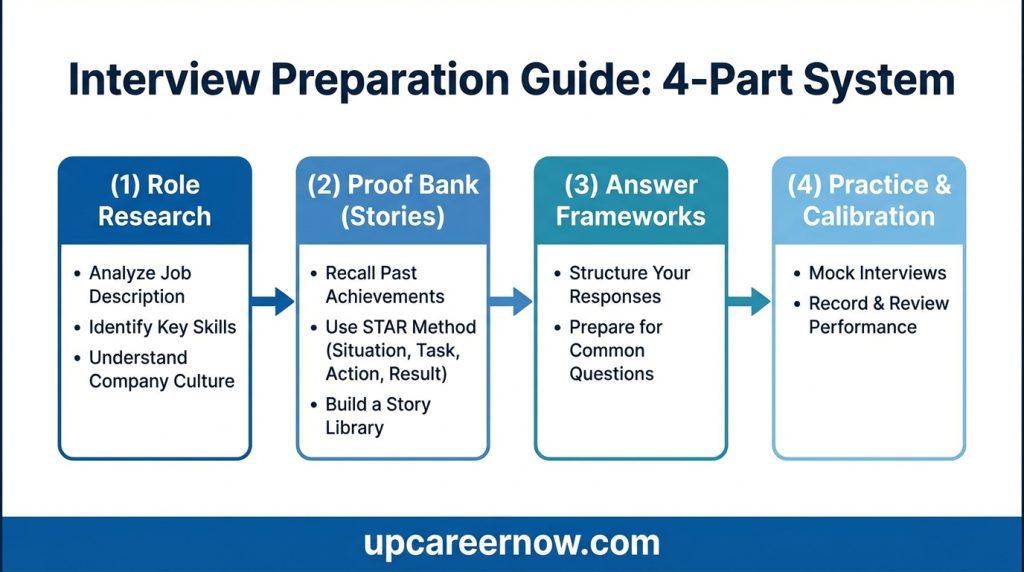
The 4-Part Interview Preparation Guide System
This interview preparation guide uses a four-part system you can reuse for almost any role. It keeps your prep efficient and prevents last-minute panic.
Part 1: Role research (what matters most)
You’re preparing to answer one question:
“Can you do this role, here, with these expectations?”
Focus on:
- what the job actually prioritizes
- what “good” looks like in this role
- what problems the team is trying to solve
Part 2: Your proof bank (examples you can reuse)
You’ll prepare 6–10 short examples that cover:
- results delivered
- problems solved
- teamwork and communication
- challenges and learning
- leadership/ownership (even if informal)
These examples fuel most answers.
Part 3: Answer frameworks (structure under pressure)
Instead of memorizing scripts, use frameworks:
- for “tell me about yourself”
- for behavioral questions
- for strengths/weaknesses
- for “why this role” and “why you”
Frameworks keep you concise.
Part 4: Practice + calibration
You’ll practice in a way that improves clarity:
- 60–90 second versions of key answers
- 20–30 second “summary” versions
- refining your examples to match the role
This creates flexibility without sounding rehearsed.
Research: What to Learn About the Role (Fast)
You don’t need to research everything. In an interview, the best signal is relevance: you understand the role’s priorities and speak to them with proof. Use this part of the interview preparation guide to get the right details quickly.
1) Extract the role’s “top 5 priorities”
From the job post, identify:
- the top responsibilities (what you’ll do weekly)
- the top skills (what you must be good at)
- the tools/processes (if mentioned)
- what success looks like (outcomes)
Turn that into a simple list:
- Priority 1: ___
- Priority 2: ___
- Priority 3: ___
- Priority 4: ___
- Priority 5: ___
2) Build a role-specific keyword list (for your talking points)
Use job language to align your answers. You’re not stuffing; you’re matching terminology so the interviewer recognizes fit.
3) Identify the likely interview focus (based on role type)
- Operations / coordination: reliability, organization, stakeholder communication
- Customer-facing: clarity, de-escalation, problem solving
- Analytical: reasoning, structure, accuracy, trade-offs
- Leadership: ownership, prioritization, coaching, decisions
4) Prepare 3 “proof angles” tied to the priorities
For each priority, write one line:
- “I’ve done this by ___, resulting in ___.”
Example:
- Priority: stakeholder coordination
Proof angle: “I aligned cross-team updates weekly to reduce confusion and keep timelines realistic.”
5) Prepare a realistic “learning plan” (if you have gaps)
If you’re missing a tool or domain detail, don’t hide it. Prepare:
- what you already know that transfers
- how you’ve learned similar things before
- your plan to ramp up responsibly
This protects credibility.
Your Story: Build Proof, Not Just Claims
Many candidates lose interviews because their answers sound like opinions: “I’m hardworking,” “I’m a great communicator,” “I’m organized.” This interview preparation guide shifts you toward proof—short, specific evidence.
Build a “proof bank” (6–10 examples)
You’ll reuse these across many questions. Aim for:
- 2 results examples (improvement, efficiency, quality, delivery)
- 2 problem-solving examples (issue → fix → outcome)
- 1 teamwork example (alignment, conflict, collaboration)
- 1 mistake/learning example (responsibility + improvement)
- 1 pressure example (deadline, high volume, complexity)
- 1 ownership example (initiative, leadership, decision)
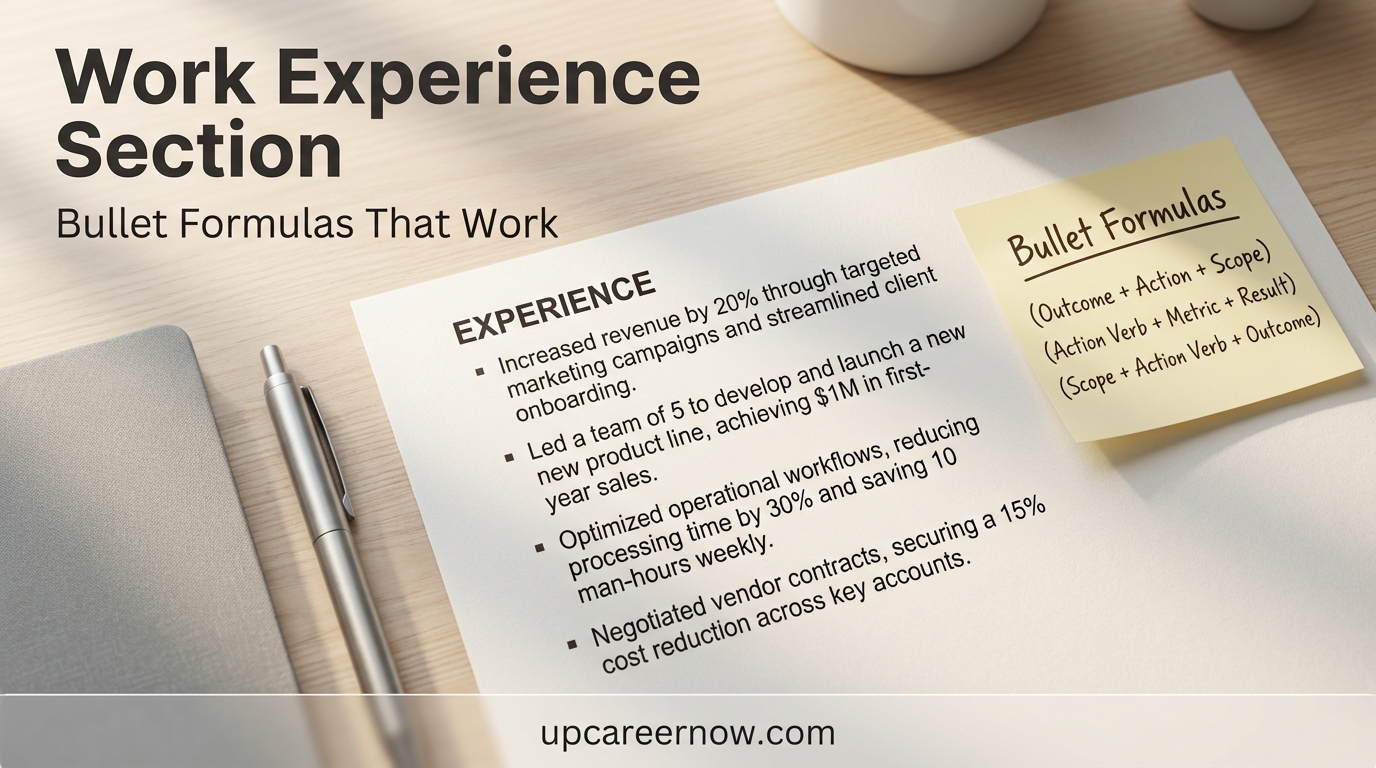
Use scope signals (even if you don’t have big metrics)
If you can’t use numbers, use credible scope details:
- frequency (weekly, daily)
- volume (high-volume, recurring)
- stakeholders (cross-team, clients, internal partners)
- complexity (multi-step, time-sensitive)
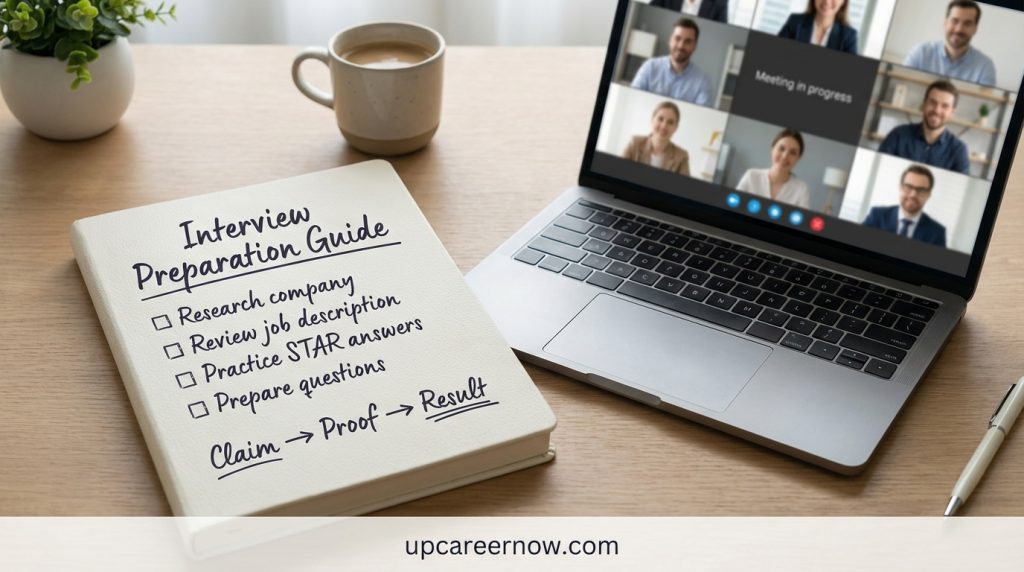
The “claim → proof → result” rule
For any claim, prepare a supporting line:
- Claim: “I’m strong at prioritization.”
- Proof: “I managed competing requests by setting weekly priorities with stakeholders.”
- Result: “It reduced last-minute changes and improved clarity.”
Keep stories short
Your best stories:
- start with the situation in one sentence
- focus on your action
- end with the result
- stay under 60–90 seconds unless asked to expand
Answer Frameworks That Keep You Clear
Frameworks reduce interview stress because they give you a reliable structure. This part of the interview preparation guide focuses on the few frameworks that cover most questions.
Framework 1: “Claim → Proof → Result” (general-purpose)
Use for many questions (strengths, leadership, teamwork, problem solving).
How it works:
- Claim: one clear statement
- Proof: one example or method
- Result: outcome or impact
Example (short):
“I’m strong at organizing cross-team work. In my last role, I created a simple weekly update system so stakeholders could see priorities and blockers. It reduced confusion and improved follow-through.”
Framework 2: “Present → Past → Future” (for fit questions)
Use for: “Why this role?” “Why are you interested?” “Why us?” (without sounding scripted).
- Present: what you’re looking for now
- Past: what you’ve done that connects
- Future: how you’ll contribute here
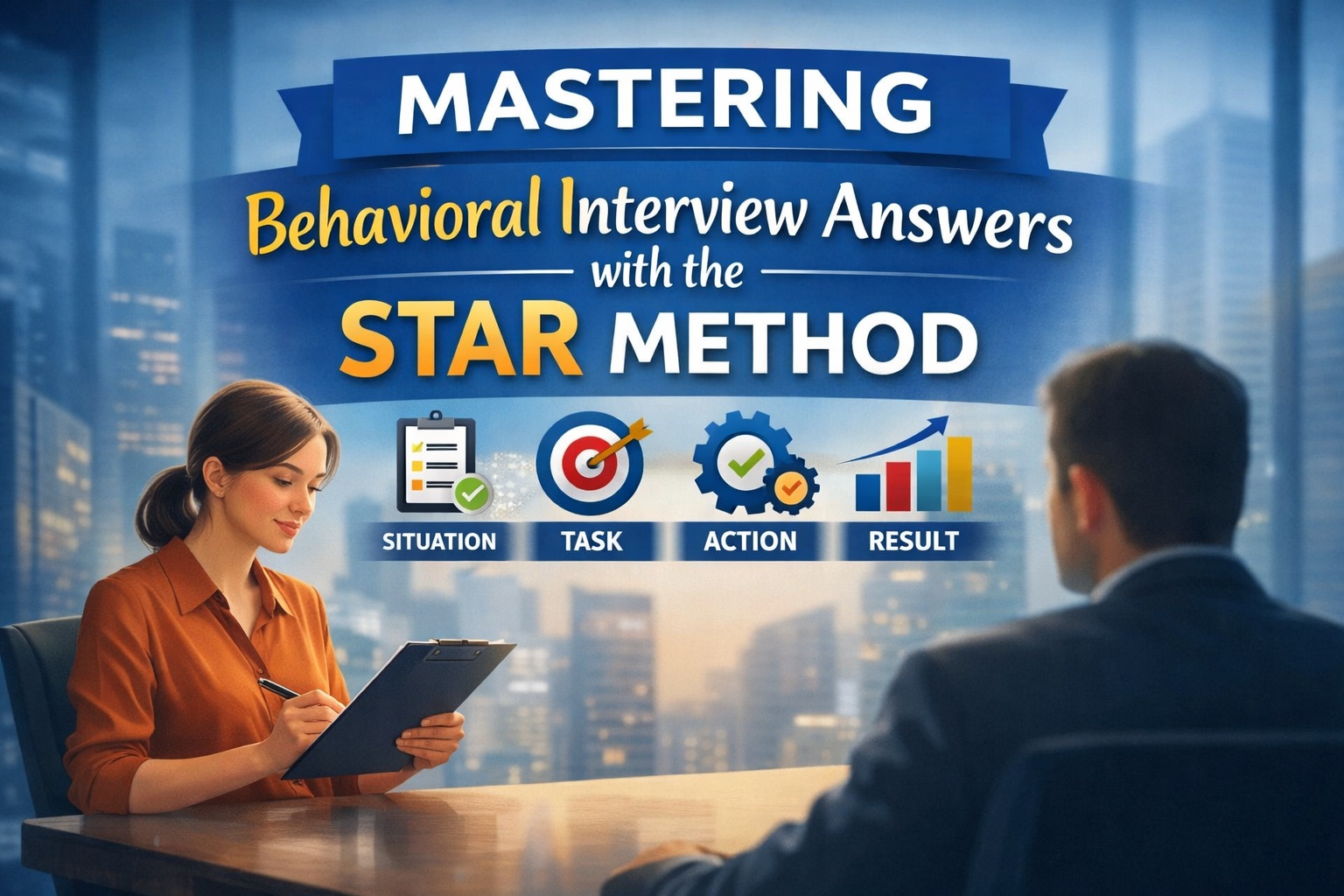
Framework 3: “S-A-R mini” (micro-STAR)
When you don’t need a long story.
- Situation: one sentence
- Action: what you did
- Result: what changed
This is ideal when time is limited.
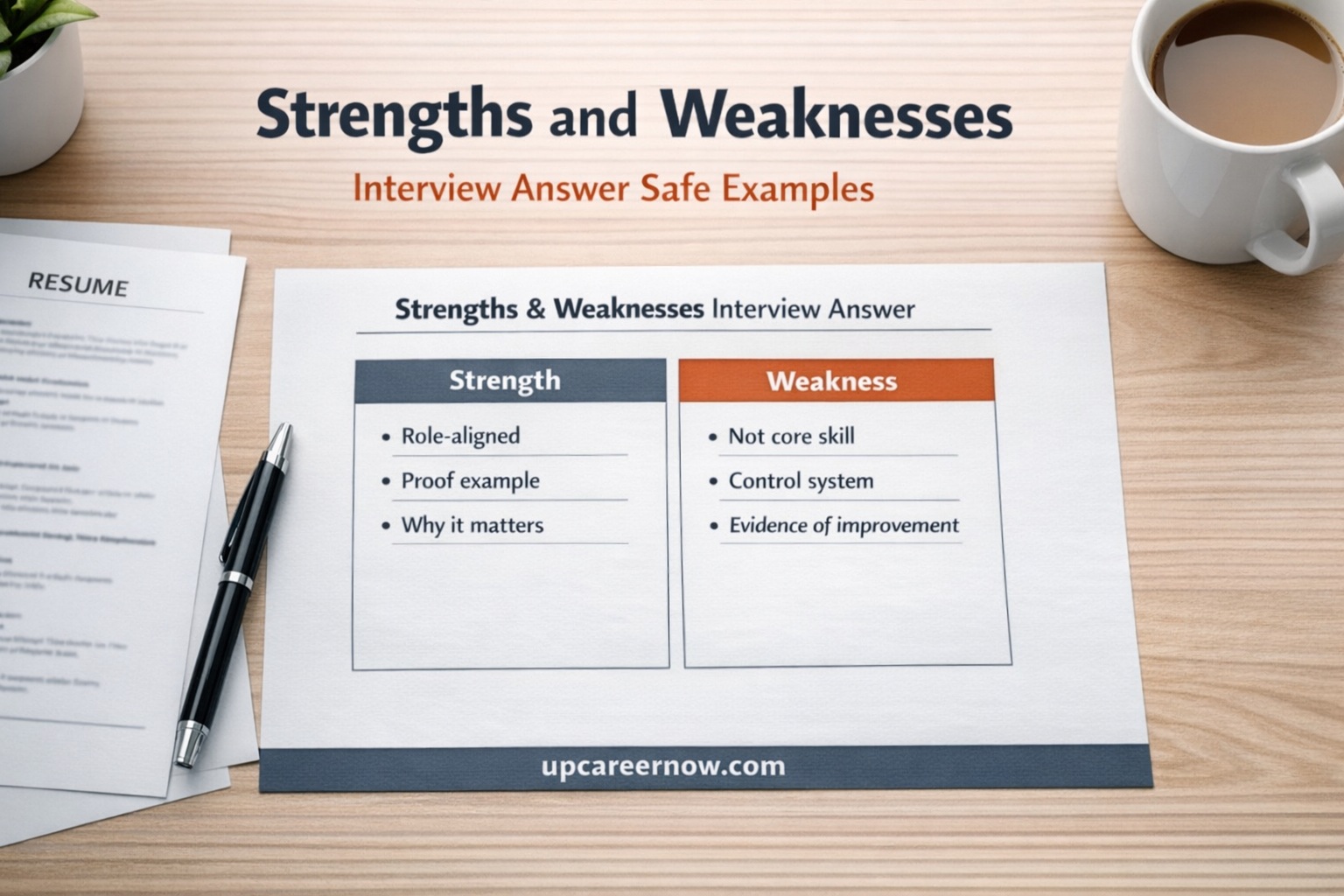
Framework 4: “Two-part answer” (for tough questions)
Use for questions like: “Tell me about a weakness,” “What would your manager say?”
- Truth (brief): a real, non-fatal weakness or challenge
- Control: what you do to manage it (system, habit, feedback loop)
This keeps the answer honest and safe.
Framework 5: “Clarify → Answer → Check” (for ambiguous questions)
Use when a question is broad or unclear.
- Clarify: ask a short clarifying question or state an assumption
- Answer: give structured response
- Check: “Does that match what you’re looking for?”
It shows maturity and prevents talking past the interviewer.
Behavioral Questions: Picking the Right Examples
Behavioral questions test how you think and work, not whether you can recite a perfect story. In this interview preparation guide, the goal is to choose examples that match the role’s priorities and show your judgment.
What behavioral questions are really measuring
Most behavioral questions look for evidence of:
- ownership (you took responsibility)
- prioritization (you chose what mattered)
- communication (you aligned people)
- problem solving (you diagnosed and fixed)
- resilience (you handled pressure and learned)
The “example selection” rules (so you don’t pick weak stories)
Choose stories where:
- you drove the action (not just “we”)
- the problem is clear in one sentence
- your decision-making is visible
- the outcome is credible (numbers or scope signals)
Avoid stories where:
- the situation is too personal or emotional
- the outcome is unclear
- your role is hard to understand
- it becomes a long explanation of everything that happened
Prepare a balanced set of examples (recommended)
Build your proof bank around these categories:
- Success example: delivered a result
- Challenge example: handled a tough situation
- Conflict example: navigated disagreement professionally
- Mistake example: owned it and improved
- Learning example: ramped up quickly and applied it
- Leadership/initiative example: improved something without being asked
How to keep behavioral answers concise
Use a short story format:
- Context (1 sentence) → what was happening
- Action (2–4 sentences) → what you did and why
- Result (1–2 sentences) → outcome + what you learned
If the interviewer wants more detail, they will ask.
Link to the deep dive
In the supporting article Strengths and Weaknesses Interview Answer (Safe Examples) (STAR method with examples)
Common Interview Questions: What They’re Really Asking
Most common questions are not traps. They’re shortcuts for evaluating fit. This interview preparation guide helps you answer them with clarity and relevance.
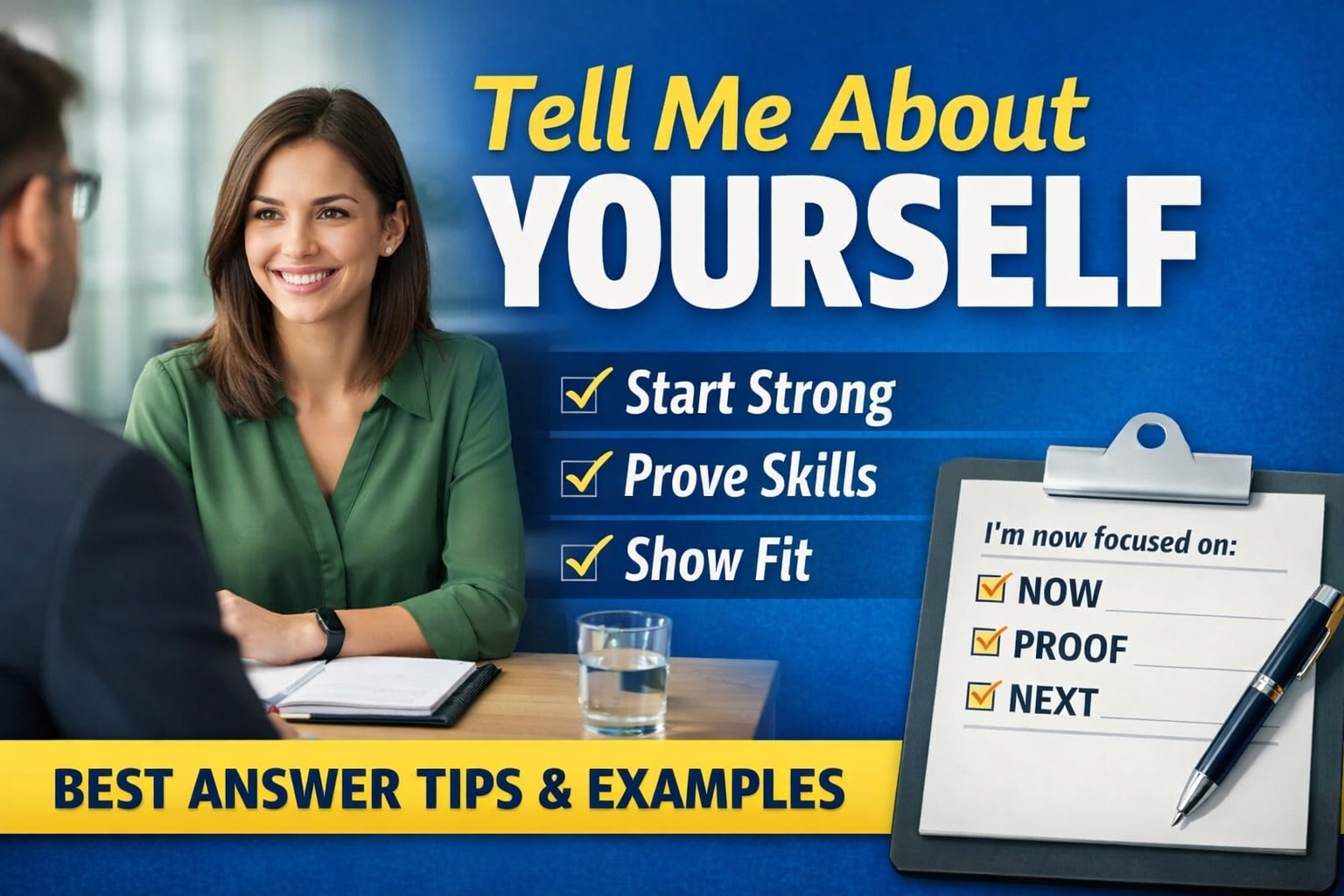
1) “Tell me about yourself”
What they’re asking: Can you summarize your professional story in a role-relevant way?
How to answer: Present → Past → Future in 60–90 seconds.
(We’ll cover full templates in the supporting article.)
2) “Why do you want this role?”
What they’re asking: Are you intentional, and do you understand the work?
How to answer: Connect 2–3 role priorities to your proof bank.
3) “Walk me through your resume”
What they’re asking: Do your choices and transitions make sense?
How to answer: Give a clean timeline + “why” behind moves + what you learned.
4) “What’s your greatest strength?”
What they’re asking: What should we rely on you for?
How to answer: One strength + one proof example + one outcome.
5) “What’s a weakness?”
What they’re asking: Do you have self-awareness and a plan?
How to answer: Truth (non-fatal) + control system (what you do to manage it).
6) “Tell me about a challenge / conflict”
What they’re asking: How do you behave under pressure with people involved?
How to answer: Situation → action → result, with a focus on your communication choices.
7) “Why should we hire you?”
What they’re asking: Can you clearly state your value?
How to answer: 2–3 fit points tied directly to their priorities, each backed by proof.
Make these questions easier to answer
If you prepare:
- top 5 role priorities
- 6–10 proof stories
- 3–4 reusable frameworks
…then most “common” questions become variations of the same answers.
Link to the deep dive
Must Read: How to answer tell me about yourself.
Technical and Task Questions: How to Respond Safely
Technical and task questions don’t always require perfect recall. They require reasoning, honesty, and a method. This part of the interview preparation guide helps you respond confidently without guessing.
1) When you know the answer
Use Explain → Example → Check:
- Explain the concept briefly
- Give a simple example (or a past situation)
- Ask if they want more depth
This keeps you clear and prevents over-talking.
2) When you partially know the answer
Use Clarify → What I know → How I’d approach:
- Clarify the exact scenario
- State what you know accurately
- Describe your approach step-by-step
Example:
“I haven’t used that exact system, but I’ve worked with similar workflows. I’d start by confirming the inputs and success criteria, then test with a small case, document the steps, and validate with a stakeholder.”
3) When you don’t know the answer
Don’t guess. Use a safe professional response:
- acknowledge the gap briefly
- explain how you would find the answer
- show your reasoning process
- if appropriate, connect to something similar you’ve learned before
This demonstrates judgment and integrity.
4) “Live task” or case questions
Many interviews include small exercises. Your goal is not speed—it’s clarity.
Use a simple structure:
- Restate the task in your words
- Ask 1–2 clarifying questions
- Outline your approach
- Execute step-by-step
- Summarize and check assumptions
5) Avoid the two risky behaviors
- Overconfidence: claiming knowledge you can’t support
- Over-explaining: burying the answer in too much detail
A calm, structured approach performs better than a rushed one.
Questions to Ask the Interviewer (Smart + Low-Risk)
Good questions show maturity and help you assess fit. In this interview preparation guide, we keep questions “low-risk”: they don’t sound demanding, but they still gather real information.
Ask questions that reveal expectations
- What would success look like in the first 30–60 days?
- What are the most important priorities for this role right now?
- What does a typical week look like?
Ask questions that reveal collaboration and workflow
- How does the team handle priorities when urgent work appears?
- Who are the main stakeholders this role works with?
- How are decisions typically made and communicated?
Ask questions that reveal growth and feedback
- How do you measure performance for this role?
- What does good feedback look like on this team?
- What are common reasons someone struggles in this role?
Ask questions that show preparation (without sounding scripted)
Use what you saw in the job description:
- I noticed the role emphasizes ___; how does that show up day-to-day?
- You mentioned ___; what tools/processes does the team use for that?
Avoid these “high-risk” questions early
- questions that sound like demands (time off, promotions, strict conditions)
- compensation-focused questions in early rounds (unless asked)
- questions that imply you’re not sure you want to work there
Keep your questions curious, role-focused, and professional.
Phone vs Video vs In-Person: Quick Differences
Your preparation should change slightly based on the interview format. This job interview preparation guide keeps it practical.
Phone interviews (audio-only)
What matters most: clarity, pace, and structure.
Do:
- keep answers shorter (30–60 seconds, expand if asked)
- smile while speaking (it changes tone)
- keep a simple notes sheet (keywords, examples, questions)
Avoid:
- reading full scripts (it sounds flat)
- multitasking (it shows in your voice)
Video interviews
What matters most: clarity + presence.
Do:
- look at the camera for key points (not the screen)
- have good lighting and stable audio
- keep notes minimal and at eye level
Avoid:
- looking down constantly
- cluttered or distracting backgrounds
- speaking too fast due to nerves
In-person interviews
What matters most: energy, listening, and consistency.
Do:
- bring a few printed copies of your resume
- pause before answering (thoughtful beats rushed)
- watch cues and adapt depth based on engagement
Avoid:
- over-filling silence
- talking past the question
- trying to “perform” instead of communicating
One principle across all formats
Structured answers outperform “more words.” Use frameworks, not scripts.
The 24-Hour Interview Preparation Checklist
This interview preparation checklist is for the day before (or morning of) an interview. It focuses on the highest return tasks.
24 hours before
- Re-read the job description and mark the top 5 priorities.
- Prepare your 30-second fit summary (role + strengths + proof).
- Pick 3–4 proof stories that match the priorities.
- Prepare 3 questions for the interviewer (role expectations + workflow).
- Do one practice run out loud for:
- “tell me about yourself”
- one behavioral story
- “why this role”
- Check your logistics:
- time zone, link/location, interview format, name/pronunciation
2–3 hours before
- Review your proof bank notes (not scripts).
- Tighten any answer that feels too long.
- Prepare 1–2 “gap statements” (how you learn missing tools safely).
- If video: test audio, lighting, and camera position.
10 minutes before
- Open your notes sheet (short bullets only).
- Take a slow breath and set your pace.
- Remind yourself: clarity beats speed.
This routine prevents last-minute chaos and helps you start with a calm, structured tone.
Decision Inputs & Outcomes
| Decision input | Your situation | Best focus | What to prepare | Likely outcome |
|---|---|---|---|---|
| Time available | 30–60 minutes | High-impact basics | Top 5 role priorities + 2 stories + 3 questions | Clear, structured answers without rambling |
| Time available | 2–3 hours | Full short prep | Top 5 priorities + 6 story bank + frameworks | Stronger proof and calmer delivery |
| Interview type | Behavioral-heavy | Story quality | STAR-ready examples + result lines | More credible and memorable answers |
| Interview type | Technical/task-heavy | Method + honesty | Clarify → Approach → Execute structure | Better judgment and fewer risky guesses |
| Confidence level | Nervous / over-talking | Short frameworks | 30-second version + 60-second version | Cleaner, more focused responses |
| Experience gap | Missing a tool/skill | Learning plan | Transferable proof + ramp-up approach | Higher trust and realistic fit |
Interview Preparation Checklist Table
| Area | Do this | Avoid this | Quick self-test |
|---|---|---|---|
| Role priorities | Write the top 5 priorities from the job post | Preparing random questions | Can you state priorities in 20 seconds? |
| Fit summary | 30-second “who I am + proof” summary | Long biography | Does it connect to the role directly? |
| Proof bank | 6–10 examples ready to reuse | Only one “best story” | Do you have stories for teamwork, challenge, learning? |
| Frameworks | Claim→Proof→Result and mini-STAR | Memorizing scripts | Can you answer without reading? |
| Questions to ask | 3 questions about success, workflow, priorities | Demanding questions early | Would these questions sound reasonable to a manager? |
| Format readiness | Test audio/video or plan arrival | Last-minute tech surprises | Is everything ready 10 minutes early? |
FAQs
1) What should an interview preparation guide include?
A good interview preparation guide should cover role research, proof stories, answer frameworks, practice routines, and questions to ask—so you’re prepared without memorizing scripts.
2) How long should interview preparation take?
It depends on the role and your familiarity. Many candidates can prepare a strong baseline in 2–3 hours by focusing on role priorities, a proof bank, and structured answers.
3) What’s the best way to practice interview answers?
Practice out loud using frameworks (Claim→Proof→Result and mini-STAR). Aim for a 30-second version and a 60–90 second version of key answers.
4) How do I stop rambling in interviews?
Use a framework, answer the question directly first, and then add proof. If you’re unsure, ask a clarifying question and keep your story short.
5) How do I prepare for behavioral interview questions?
Prepare 6–10 stories (success, challenge, conflict, mistake, learning, ownership) and practice telling each in 60–90 seconds with a clear result.
6) What questions should I ask the interviewer?
Ask about success expectations, priorities, team workflow, stakeholders, and how performance is measured. Avoid demanding or overly personal questions early.
7) Is this interview preparation guide useful for phone and video interviews?
Yes. The same preparation applies, but phone interviews reward shorter answers and video interviews require extra attention to pace, presence, and audio quality.
8) What should I do if I don’t know an answer?
Don’t guess. Briefly acknowledge the gap, explain how you’d approach it, and connect to similar experience where appropriate.
Limitations and Disclaimer
“Career information on UpCareerNow is provided for general guidance and planning purposes only. Actual outcomes depend on skills, experience, location, and market conditions.”
Ad & Content Safety Note
This guide is designed to be practical and AdSense-safe. It avoids guarantees and encourages honest, defensible answers. Interview processes vary by employer and role, so use these frameworks as a baseline and adapt to each interview context.