
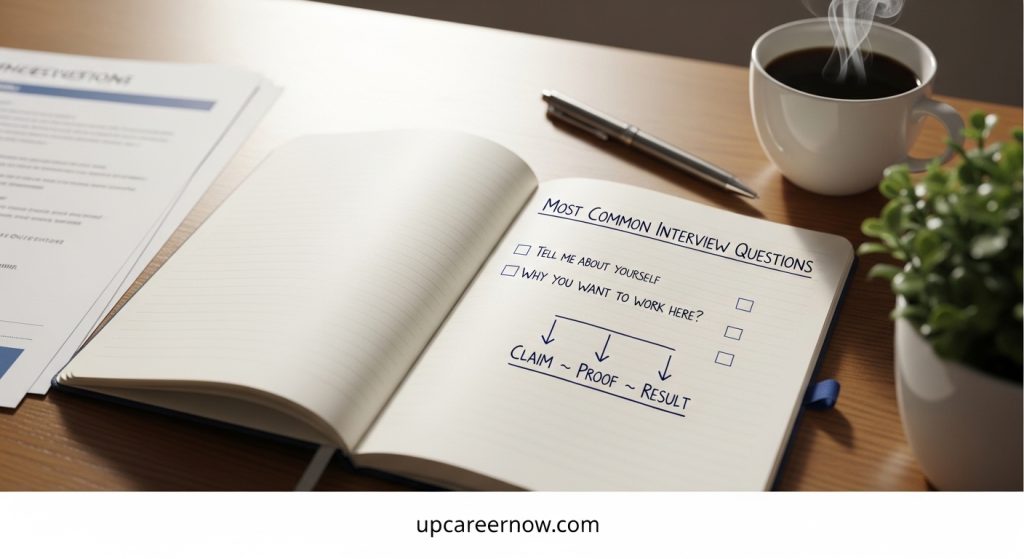
The most common interview questions are not random. They repeat because they quickly reveal whether you understand the role, can communicate clearly, and can back your claims with proof. The difference between an average answer and a strong answer is usually structure: you answer the real question, stay concise, and support it with one relevant example.
This guide gives you reusable frameworks for the common questions you’ll see across many jobs—so you can prepare once and adapt fast. For the full preparation system (research, proof bank, practice routine), use our hub:
Must Read: Interview Preparation Guide
How to Use This Guide
This article is built for speed. You can use it in two ways:
Option A: Prepare for one interview (fast)
- Read the 5 answer frameworks.
- Pick 8–10 questions from the list below that match your interview stage.
- Write bullet-point notes (not scripts) using the framework template.
- Practice out loud once per question (30–90 seconds).
Option B: Build a reusable system (best long-term)
- Create a proof bank of 6–10 stories (success, challenge, conflict, mistake, learning).
- Map each story to 2–3 question types (behavioral, teamwork, problem solving).
- Use the same frameworks repeatedly, updating only the role-specific details.
The 5 Answer Frameworks You’ll Reuse
These frameworks work because they keep you focused. They prevent rambling and help you include proof naturally—especially for most common interview questions.
Framework 1: Present → Past → Future (role fit)
Use for: “Tell me about yourself,” “Why this role,” “Why are you interested?”
- Present: what you do now / what you’re focused on
- Past: one proof highlight that connects
- Future: how you’ll contribute in this role
1-sentence template:
“I’m currently ___; previously I ___ (proof); and I’m excited about this role because I can ___ (contribution).”
“For frameworks to answer behavioral questions specifically…”
→ behavioral-star-method-examples
Framework 2: Claim → Proof → Result (general-purpose)
Use for: strengths, “why should we hire you,” “what makes you effective.”
- Claim: one clear strength/value
- Proof: one example or method
- Result: outcome or impact
Framework 3: Mini-STAR (behavioral short)
Use when time is short.
- Situation: 1 sentence
- Action: 2–3 sentences
- Result: 1 sentence
Framework 4: Clarify → Answer → Check (ambiguous questions)
Use when the question is broad or unclear.
- Clarify the situation or state an assumption
- Answer in structured steps
- Check: “Is that the kind of example you’re looking for?”
Framework 5: Truth → Control (weakness / gap questions)
Use for: weaknesses, gaps, missing tools, failure or mistake questions.
- Truth: brief, non-fatal weakness or gap
- Control: what you do to manage it (system, habit, feedback loop)
Use notes, not scripts. Frameworks make you consistent while still sounding human.
Most Common Interview Questions (with Best Answer Structures)
Below are the most common interview questions across many roles. For each question, you’ll see:
- what the interviewer is really trying to learn
- the safest structure to answer
- a short example outline you can adapt
1) “Tell me about yourself.”
What they’re assessing: role fit + communication clarity.
Best structure: Present → Past → Future.
Example outline:
- Present: current focus and strengths
- Past: one proof highlight relevant to the role
- Future: why this role is a logical next step
Deep dive: We’ll link the “Tell me about yourself” supporting article here once published.
2) “Walk me through your resume.”
What they’re assessing: your story makes sense and your decisions are intentional.
Best structure: Timeline → Skills growth → Role fit.
Example outline:
- 2–3 role milestones
- what you learned / improved
- why this role matches now
3) “Why do you want this role?”
What they’re assessing: motivation + understanding of the work.
Best structure: Present → Past → Future (fit version).
Example outline:
- Role priorities you care about
- your proof that connects
- how you would contribute
4) “Why should we hire you?”
What they’re assessing: can you clearly communicate value.
Best structure: Claim → Proof → Result (2–3 fit points).
Example outline:
- Fit point #1 tied to priority + proof
- Fit point #2 tied to priority + proof
- Optional: how you’ll ramp up fast
5) “What are your strengths?”
What they’re assessing: what they can rely on you for.
Best structure: Claim → Proof → Result.
Example outline:
- Strength (clear)
- one example
- outcome and how it helps this role
6) “What is your biggest weakness?”
What they’re assessing: self-awareness + growth.
Best structure: Truth → Control.
Example outline:
- Weakness (safe, not core to role)
- what you do to manage it
- proof that it improved
7) “Tell me about a time you handled a challenge.”
What they’re assessing: resilience + problem solving.
Best structure: Mini-STAR.
Example outline:
- challenge context
- action you took (and why)
- result + what you learned
8) “Tell me about a time you made a mistake.”
What they’re assessing: accountability + learning.
Best structure: Mini-STAR + learning emphasis.
Example outline:
- what happened (brief)
- what you did to fix it
- what changed in your process after
9) “Tell me about a time you worked with a difficult person.”
What they’re assessing: communication + maturity.
Best structure: Mini-STAR with “tone control.”
Example outline:
- conflict cause (neutral, no blame)
- how you communicated
- outcome + relationship result
10) “Where do you see yourself in 2–3 years?”
What they’re assessing: realism + alignment.
Best structure: Direction → Skills → Contribution.
Example outline:
- direction aligned with role
- skills you’re building
- how you plan to contribute here
Hard Questions That Still Show Up Often
These aren’t always asked, but they’re common enough that preparing them makes you calmer. They also tend to separate strong candidates from average ones—even when the role is similar.
1) “Why are you leaving your current job?”
What they’re assessing: professionalism + stability.
Safe structure: Neutral reason → what you want next → role alignment.
Safe outline:
- “I’m looking for ___ (growth, scope, learning).”
- “I enjoyed ___, but I want more ___.”
- “This role matches because ___.”
Avoid negativity and long stories.
2) “Tell me about a time you disagreed with your manager.”
What they’re assessing: judgment + communication.
Safe structure: Context → respectful approach → outcome.
Outline:
- what the decision was
- how you raised your view (data, options)
- what you did after the decision (support execution)
3) “What motivates you?”
What they’re assessing: fit with role realities.
Safe structure: Motivation → proof → tie to role.
Example: learning, problem solving, customer impact, building systems.
4) “How do you handle pressure?”
What they’re assessing: coping strategy + reliability.
Safe structure: Method → example → result.
Outline: prioritize, communicate early, break tasks down, confirm expectations.
5) “What is your expected salary?”
What they’re assessing: alignment + risk.
Safe structure: Research-based range → flexibility → value focus.
Outline:
- “Based on the role scope and market context, I’m targeting __ to __.”
- “I’m open to learning more about the full package and expectations.”
(We’ll cover negotiation in a separate supporting article later if you want.)
6) “Why do you have a gap / change?”
What they’re assessing: clarity and stability.
Safe structure: brief truth → what you did → readiness now.
Outline: keep it short, highlight learning or responsibility.
7) “What would your coworkers say about you?”
What they’re assessing: self-awareness + teamwork.
Safe structure: 2 traits → 1 example each.
Keep it grounded and consistent with your resume.
Questions to Ask the Interviewer (Quick Options)
A strong finish can lift an interview. These questions are “safe” because they’re role-focused and not demanding.
About success and expectations
- What would success look like in the first 30–60 days?
- What are the most important priorities for this role right now?
- What are the biggest challenges the team wants this hire to help with?
About workflow and collaboration
- Who are the main stakeholders this role works with?
- How does the team handle shifting priorities and urgent work?
- What does communication look like day-to-day?
About performance and feedback
- How is performance measured for this role?
- What does good feedback look like on this team?
- What are common reasons someone struggles in this role?
About the interview process
- What are the next steps and timeline?
- Is there anything I can clarify about my experience to be more helpful?
If you want a complete system for interview questions + prep routine, must read: Interview-preparation-guide.
Practice Plan: 30 Minutes to Interview-Ready
This plan works when you don’t have time to “prepare everything,” but you still want structure. It’s built around the most common interview questions.
Minute 1–5: Pick your priority questions
Choose 6–8 questions for your round:
- tell me about yourself
- why this role
- strengths
- one challenge (behavioral)
- one teamwork/conflict
- why should we hire you
- one weakness or mistake
- questions to ask
Minute 6–15: Write frameworks as bullet notes
For each question:
- write the framework title (Present→Past→Future, Claim→Proof→Result, Mini-STAR)
- add 3–5 bullet notes only
Avoid full sentences.
Minute 16–25: Practice out loud (once each)
- 30-second version first
- then expand to 60–90 seconds if needed
Record yourself if possible and remove extra words.
Minute 26–30: Calibrate
- shorten anything that feels long
- make sure each answer connects to the role priorities
- prepare 2–3 questions for the interviewer
This keeps you confident and coherent even when time is tight.
Decision Inputs & Outcomes
| Scenario you’re in | Use this framework | What to say (in 1–2 lines) | What not to do |
|---|---|---|---|
| You’re asked “Tell me about yourself” in the first 2 minutes | Present → Past → Future | Role identity now → one proof highlight → why this role is a logical next step | Start from childhood, list every job, or give a long timeline |
| They ask “Why should we hire you?” late in the interview | Claim → Proof → Result (2–3 points) | Two fit claims tied to their priorities, each backed by one proof line | Repeat the resume with no evidence or speak in generalities |
| Behavioral question and you feel the story getting long | Mini-STAR | One-sentence context → 2–3 action steps → one clear result + learning | Turn it into a full project history with no outcome |
| Weakness question and you want to sound honest but safe | Truth → Control | A real, non-fatal weakness + the system you use to manage it + proof it improved | “I’m a perfectionist” or a weakness that’s core to the job |
| You don’t fully understand the question or it’s too broad | Clarify → Answer → Check | Ask 1 clarifier (or state an assumption), answer with structure, confirm it matches | Guess what they mean and talk for 2 minutes in the wrong direction |
| You have little experience, but need credible answers | Claim → Proof → Result + scoped proof | Use projects, volunteering, coursework; add scope signals (frequency, stakeholders) | Claim skills with no example or overstate responsibility |
Common Interview Questions Checklist Table
| Score area | 0 = Weak | 1 = OK | 2 = Strong | Quick fix if you scored 0–1 |
|---|---|---|---|---|
| Directness | You don’t answer the question clearly | You answer, but with extra detours | You answer in the first sentence | Start with a one-line answer, then add proof |
| Structure | No framework; it sounds scattered | Some structure, but inconsistent | Clear framework used naturally | Pick one framework per question and label it in your notes |
| Proof | Claims only (“I’m hardworking”) | Example exists but feels vague | Concrete example with clear action | Add one specific action + one scope cue (weekly, volume, stakeholders) |
| Relevance | Answer doesn’t connect to the role | Partially connected | Directly tied to role priorities | Rewrite one sentence using the job’s priority language |
| Length | Too long; the main point gets lost | Borderline long | Concise (30–90 seconds) | Cut the setup; keep context to one sentence |
| Confidence | Hesitant, over-explaining | Mostly steady | Calm and controlled | Practice the 30-second version twice before the 60-second version |
| Questions you ask | No questions or risky questions | Basic questions | Role-focused questions about success and workflow | Prepare 3 questions: success, priorities, collaboration |
Author Bio
Author: UpCareerNow Editorial & Research Team
Role: Editorial team specializing in interview preparation, communication clarity, and hiring-aligned career guidance.
Bio: The UpCareerNow Editorial & Research Team creates practical, structured resources that help candidates prepare calmly and communicate clearly. This article focuses on the most common interview questions, giving reusable answer frameworks and practice methods that stay honest, concise, and interview-safe.
FAQs
1) How do I prepare for most common interview questions quickly?
Pick 6–8 questions that match your interview stage, assign one framework to each (Present→Past→Future, Claim→Proof→Result, Mini-STAR, Truth→Control), and practice a 30-second version out loud first. Then expand to 60–90 seconds only if needed.
2) What’s the best way to answer most common interview questions without sounding rehearsed?
Use bullet notes, not scripts. Keep your structure consistent, but vary wording naturally. The goal is to sound prepared, not memorized.
3) How long should “Tell me about yourself” be?
Aim for 60–90 seconds. Lead with what you do now, give one proof highlight, and end with why this role makes sense next.
4) What should I do if I’m asked a question I didn’t prepare?
Use Clarify → Answer → Check. Ask one clarifying question (or state an assumption), give a structured answer, and confirm it matches what they want.
5) How do I answer weakness questions safely?
Use Truth → Control: name a real but non-fatal weakness, then explain the system you use to manage it (habit, checklist, feedback loop), plus proof it improved.
6) How do I stop rambling when I’m nervous?
Answer in the first sentence, then add one proof example. If you notice you’re expanding too much, end with a check: “Would you like a second example?”
7) What if I don’t have “big achievements” for strong answers?
Use scope signals instead of big numbers: frequency (weekly), volume (high-volume), stakeholders (cross-team), complexity (multi-step). Proof beats exaggeration.
8) What questions should I ask at the end?
Ask about priorities, success expectations, team workflow, and how performance is measured. Avoid demanding questions early.
Limitations and Disclaimer
“Career information on UpCareerNow is provided for general guidance and planning purposes only. Actual outcomes depend on skills, experience, location, and market conditions.”
Ad & Content Safety Note
This article is designed to be practical and AdSense-safe. It avoids guarantees and encourages honest, defensible interview answers. Interview formats vary, so treat these frameworks as a baseline and adapt to each role and interviewer style.
