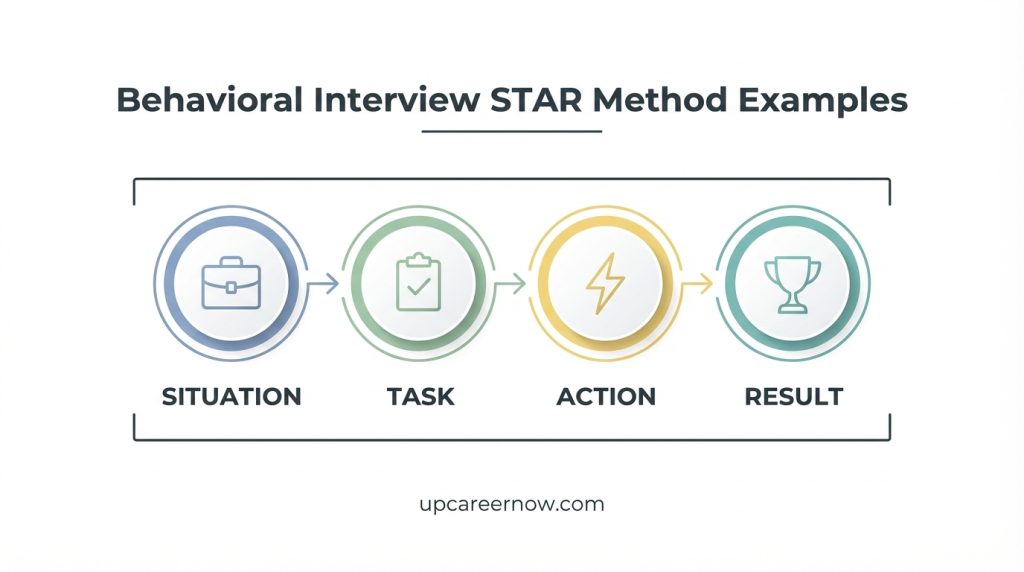
Behavioral interview STAR method examples help you turn “Tell me about a time…” questions into short, credible proof. The STAR structure (Situation, Task, Action, Result) keeps your answer focused, shows your decision-making, and makes it easier for interviewers to evaluate your skills consistently.
In this guide, you’ll learn how to build a small “story bank,” choose the right example fast, and deliver STAR answers that sound natural (not robotic)—with ready-to-adapt examples for common behavioral interview questions.
“Before practicing STAR, refine your overall interview strategy.”
→ interview preparation guide
What is a behavioral interview and why STAR works
A behavioral interview focuses on what you actually did in past situations to predict how you’ll handle similar situations at work. You’ll usually hear prompts like:
- “Tell me about a time you disagreed with a coworker.”
- “Describe a situation where you had to prioritize competing deadlines.”
- “Give me an example of when you made a mistake.”
The STAR method helps because it matches how interviewers evaluate answers: context, your responsibility, your choices, and outcome. It also protects you from the two biggest risks in behavioral interview questions:
- Rambling (too much background, not enough decision-making)
- Unclear ownership (“we did…” with no evidence of what you did)
Quick rule: In most roles, your “Action” should be the longest part. “Situation” should be the shortest.
Mini-template (say it like this):
- Situation: One sentence on the setting and stakes
- Task: Your responsibility (what success looked like)
- Action: 2–4 actions you personally took (tools, tradeoffs, communication)
- Result: Outcome + what changed + what you learned
“Need to polish your fundamental answers (like ‘Tell me about yourself’)?”
→ tell-me-about-yourself
How to build a STAR story bank in 30 minutes
A STAR story bank is a small set of reusable examples you can quickly match to most behavioral interview questions. You don’t need 30 stories. You need 6–10 strong ones that cover the most common skills.
Step 1: Pick 8 “core skills” interviewers test
Choose stories that prove these (they map to most behavioral interview questions):
- Collaboration
- Ownership
- Communication
- Problem-solving
- Prioritization
- Handling conflict
- Learning/adaptability
- Leadership (formal or informal)
If you’re early-career, leadership can be “led a task” (not “managed people”).
Step 2: Use a simple story selection rule
Aim for stories that have clear stakes and a visible change. Good story signals:
- A deadline, an error, a customer impact, or a process that was failing
- A decision with tradeoffs
- An outcome you can describe (numbers help, but they’re not required)
Avoid stories where you only “assisted” and can’t explain your choices.
Step 3: Fill this STAR worksheet for each story
Keep it tight. One story should fit on half a page.
- Situation (1–2 lines): Where, when, and why it mattered
- Task (1 line): What you were responsible for
- Actions (3–5 bullets): What you did (tools, decisions, communication)
- Result (1–2 lines): Outcome + what improved + what you learned
Step 4: Add “tags” so you can retrieve stories fast
Next to each story, add 3–5 tags. Example:
conflict,cross-functional,tight deadline,data cleanup,customer escalation
When you hear the question, you scan tags and choose the closest match.
STAR Story Bank Planner (fillable)
| Skill this story proves | Story title (2–5 words) | Best question matches | Key actions (your choices) | Result (what changed) | Tags (3–5) |
|---|---|---|---|---|---|
| Prioritization | Deadline triage | “How do you prioritize?” | Re-scoped, negotiated, tracked | Delivered on time, reduced rework | |
| Conflict | Disagreement reset | “Tell me about a conflict.” | Clarified goals, proposed options | Alignment reached, faster handoff | |
| Problem-solving | Root cause fix | “Solve a hard problem.” | Diagnosed, tested, documented | Issue resolved, fewer repeats |
Step 5: Create “one story, many questions” mapping
One strong story can answer multiple behavioral interview questions if you adjust the framing.
Example: “Root cause fix” can answer:
- “Tell me about a mistake.” (frame as learning)
- “Tell me about problem-solving.” (frame as diagnosis)
- “Tell me about improving a process.” (frame as prevention)
This is why building behavioral interview STAR method examples as a bank is so efficient.
Step 6: Do a 2-minute out-loud test
Say it out loud once. If it takes longer than 90 seconds, tighten:
- Cut background from Situation
- Move details into Actions
- Make Result concrete (what improved)
A good STAR answer typically lands in 45–90 seconds for most behavioral interview questions.
The STAR script that sounds natural (not rehearsed)
The fastest way to make STAR feel human is to speak in sentences, not labels. You can still follow the structure—just hide it.
The “one-breath” STAR opener
Use this to start smoothly and set context without rambling:
- “A quick example is when [short situation]. My responsibility was [task]. What I did was [action]. The outcome was [result].”
It’s simple, direct, and it signals you’ll be organized.
The natural STAR flow (what to say, in order)
1) Situation (1 sentence)
Focus on stakes and constraints.
- “We had a deadline in two days and the handoff wasn’t clear.”
2) Task (1 sentence)
Say what success looked like.
- “I needed to clarify ownership and make sure the deliverable shipped with minimal rework.”
3) Action (2–4 sentences)
This is the “proof” section. Lead with decisions, not effort.
Use this pattern:
- Decision → What you did → Why you chose it → Who you aligned with
Example:
- “I scheduled a 15-minute alignment call, then wrote a one-page checklist with owners. I chose that because the issue was ambiguity, not capability. I confirmed priorities with the lead and updated everyone in one thread.”
4) Result (1–2 sentences)
Make it measurable if possible. If not, make it observable.
- “We shipped on time, and the checklist became the standard for future handoffs.”
The “Action” upgrade: make your choices visible
Interviewers are listening for how you think. Add one of these lines inside Actions:
- “The tradeoff was X vs Y, so I chose Y because…”
- “I ruled out option A because…”
- “The risk was __, so I mitigated it by…”
This turns a basic story into strong evidence.
STAR Answer Quality Checklist (self-score)
| Section | What “weak” sounds like | What “strong” sounds like | Quick fix line you can add |
|---|---|---|---|
| Situation | Too much background | One sentence with stakes | “The main constraint was ___.” |
| Task | Unclear responsibility | Clear ownership + target | “Success meant ___ by ___.” |
| Action | “We did…” + no decisions | Your choices + why | “I chose ___ because ___.” |
| Result | Vague (“it went well”) | Observable change/impact | “As a result, ___ improved by ___.” |
Micro-examples (45 seconds each) you can adapt quickly
Example A: Prioritization
“A quick example is when two urgent requests landed the same day. My responsibility was to deliver the higher-impact work without missing commitments. What I did was list deadlines and impact, confirm priorities with the owner, then split the work into a ‘must-ship today’ and ‘ship tomorrow morning’ plan. The outcome was we met the critical deadline and avoided last-minute rework because expectations were set early.”
Example B: Conflict
“A quick example is when a teammate and I disagreed on approach. My responsibility was to keep the project moving and protect the timeline. What I did was clarify the goal, propose two options with risks, and ask for a quick decision checkpoint with our lead. The outcome was we aligned on one path the same day and improved communication by documenting decisions.”
These are behavioral interview STAR method examples in their simplest form: short context, clear ownership, visible choices, and a real outcome.
Behavioral interview STAR method examples by skill
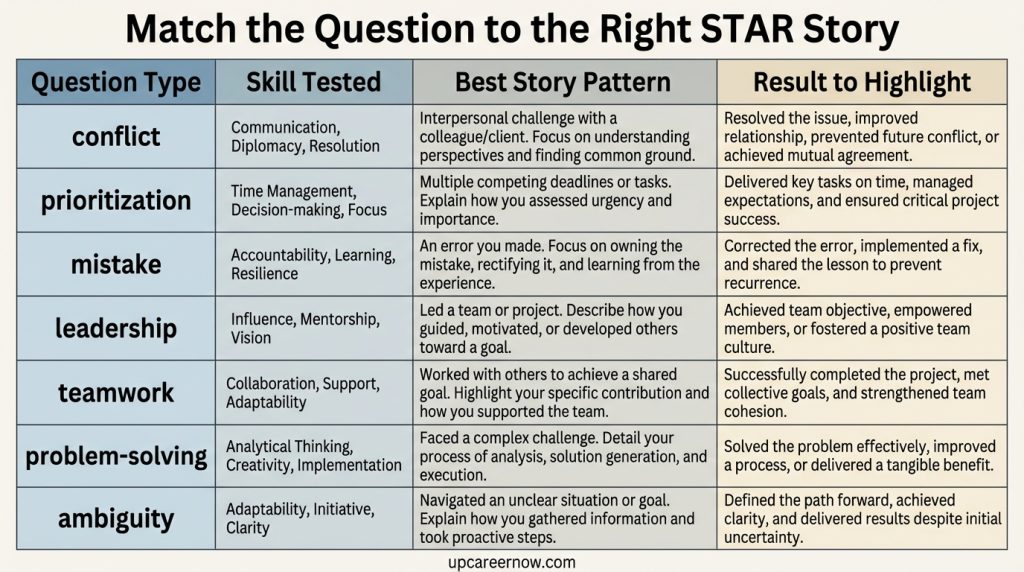
Below are ready-to-adapt behavioral interview STAR method examples mapped to the skills interviewers most often test. Don’t memorize word-for-word. Borrow the structure, swap in your details, and keep the answer to 45–90 seconds.
1) Teamwork and collaboration
Common question: “Tell me about a time you worked across teams.”
- Situation: Two teams had different priorities, and the handoff kept breaking.
- Task: I needed to align requirements and reduce back-and-forth.
- Action: I set up a short weekly checkpoint, created a shared checklist, and clarified owners for each step. I chose a checklist because the failure point was unclear inputs, not effort.
- Result: Handoffs became predictable, and rework dropped because requirements were confirmed before work started.
What this proves: collaboration, communication, process improvement.
2) Handling conflict
Common question: “Describe a conflict and how you handled it.”
- Situation: A teammate pushed for a fast approach that risked quality.
- Task: I needed to protect the outcome without escalating tension.
- Action: I asked clarifying questions, summarized our shared goal, and offered two options with tradeoffs. I proposed a quick pilot to reduce uncertainty.
- Result: We agreed on a safer approach, hit the deadline, and kept the relationship strong.
What this proves: maturity, influence, decision-making under pressure.
3) Problem-solving
Common question: “Tell me about a difficult problem you solved.”
- Situation: A recurring issue kept causing delays.
- Task: I was responsible for finding the root cause and preventing repeats.
- Action: I gathered examples, mapped where failures happened, tested likely causes, and documented a new standard process. I ruled out quick fixes that didn’t address the root.
- Result: The issue stopped repeating, and the team had a clearer process going forward.
What this proves: structured thinking, initiative, prevention mindset.
4) Ownership and accountability
Common question: “Tell me about a time you took ownership.”
- Situation: A task was falling between roles, and progress stalled.
- Task: I needed to move it forward and clarify ownership.
- Action: I volunteered to coordinate, defined the next steps, assigned clear owners, and set check-in milestones. I communicated progress in one thread to reduce confusion.
- Result: The work restarted, deadlines became clear, and future tasks had an owner from day one.
What this proves: leadership, reliability, communication.
5) Prioritization and time management
Common question: “How do you prioritize when everything is urgent?”
- Situation: I had multiple urgent requests with competing deadlines.
- Task: I needed to deliver the highest-impact work first without breaking commitments.
- Action: I ranked tasks by impact + deadline, confirmed priorities with stakeholders, and split work into “today vs next” milestones. I flagged risks early.
- Result: The critical work shipped first, and expectations stayed aligned—no surprises.
What this proves: judgment, planning, stakeholder management.
6) Making a mistake and learning
Common question: “Tell me about a mistake you made.”
- Situation: I missed an important detail that caused rework.
- Task: I needed to fix it quickly and prevent recurrence.
- Action: I owned the error, communicated the fix plan, updated the deliverable, and created a simple checklist to catch that issue next time.
- Result: The issue was resolved, trust was repaired through transparency, and the checklist improved quality afterward.
What this proves: accountability, learning, process improvement.
7) Leadership without authority
Common question: “Tell me about a time you led without being the manager.”
- Situation: A group task had no clear coordinator, and deadlines were drifting.
- Task: I needed to get alignment and build momentum.
- Action: I proposed a plan, broke work into small tasks, invited input, and tracked progress. I kept updates short and consistent to reduce friction.
- Result: The team hit the deadline, and coordination improved for the next project.
What this proves: initiative, facilitation, clarity.
How to quantify results (even when you don’t have numbers)
Strong behavioral interview STAR method examples usually win or lose in the Result. Interviewers want evidence that something changed because of your actions. If you don’t have metrics, you can still be specific.
Option 1: Use “before vs after” (observable outcomes)
Instead of “It improved,” say what became different.
- Before: unclear ownership, repeated revisions, slow handoffs
- After: owners defined, fewer revisions, faster turnaround
Result line you can use:
- “Before, we had ___; after implementing ___, we saw ___.”
Option 2: Use “scale” (scope is a metric)
Scope shows impact even without exact numbers.
Examples of scale indicators:
- Number of stakeholders involved
- Number of handoffs or teams
- Frequency (daily/weekly/monthly)
- Time window (in one week, over a quarter)
Result line:
- “This affected ___ teams / ___ stakeholders over ___ weeks.”
Option 3: Use “time saved” (estimate carefully)
Even a conservative estimate is helpful if you frame it as approximate.
Result line:
- “It reduced turnaround time by roughly ___ (for example, from days to hours).”
Avoid exaggeration. Keep it believable.
Option 4: Use “risk reduced” (what you prevented)
Prevention is real impact. You just need to name the risk.
Examples:
- Fewer errors
- Fewer escalations
- Fewer last-minute changes
- Lower chance of missing deadlines
Result line:
- “It reduced the risk of ___ by adding ___.”
Option 5: Use “quality signal” (what improved in the work)
Quality can be shown through fewer revisions, clearer requirements, or smoother approvals.
Result line:
- “Revisions decreased because requirements were confirmed upfront.”
The RESULT formula (easy and natural)
Use this 3-part structure:
- Outcome: what happened
- Impact: what improved (time, quality, risk, alignment, satisfaction)
- Learning: what you’d repeat next time
Example:
- “We shipped on time (outcome), rework dropped because we clarified inputs early (impact), and I now standardize a short checklist on handoffs (learning).”
This keeps your behavioral interview STAR method examples credible and complete.
Mini examples: turning vague results into strong results
Vague: “It went well and the team was happy.”
Stronger: “We aligned in one meeting, shipped on time, and the checklist reduced confusion on the next handoff.”
Vague: “I improved the process.”
Stronger: “I documented steps and owners, which reduced repeat questions and made approvals faster.”
Vague: “I fixed the issue.”
Stronger: “I identified the root cause, implemented a prevention step, and the issue stopped recurring.”
Understood. Continuing with the next heading.
Common STAR mistakes (and quick fixes)
Even strong candidates weaken their answers with small STAR execution errors. Use this section as a rapid self-audit before interviews.
Mistake 1: Too much background in Situation
What it sounds like:
Long explanations about company history, org charts, or side details.
Why it hurts:
Interviewers lose the thread before you reach your actions.
Quick fix:
Limit Situation to one sentence and state the constraint.
Upgrade line:
“The main challenge was ___.”
Mistake 2: Saying “we” instead of “I”
What it sounds like:
“We decided… We implemented… We fixed…”
Why it hurts:
Your personal contribution is unclear.
Quick fix:
Switch to I + verb.
Upgrade line:
“I analyzed ___, then I decided to ___.”
Mistake 3: Describing effort instead of decisions
What it sounds like:
“I worked really hard and stayed late.”
Why it hurts:
Effort ≠ impact. Interviewers want judgment and reasoning.
Quick fix:
Add why you chose that approach.
Upgrade line:
“I chose ___ because ___.”
Mistake 4: Weak or missing result
What it sounds like:
“It worked out.”
“The team was happy.”
Why it hurts:
No evidence of value.
Quick fix:
Use outcome + impact.
Upgrade line:
“As a result, ___ improved / decreased / became faster.”
Mistake 5: No learning or reflection
What it sounds like:
Story ends immediately after result.
Why it hurts:
Missed chance to show growth mindset.
Quick fix:
Add one short lesson.
Upgrade line:
“What I learned from this was ___.”
Mistake 6: Overly rehearsed, robotic delivery
What it sounds like:
Rigid, memorized phrasing.
Why it hurts:
Feels inauthentic.
Quick fix:
Use conversational transitions.
Upgrade lines:
- “A good example is when…”
- “What I did next was…”
- “The outcome was…”
Mistake 7: Choosing the wrong story
What it sounds like:
Great story, but doesn’t match the question.
Why it hurts:
Signals poor listening.
Quick fix:
Pause 2 seconds. Identify the skill being tested first.
Mental check:
“Are they testing teamwork, judgment, or ownership?”
60-Second STAR self-check
Before interviews, run each story through this:
- Situation = 1 sentence
- Task = clear responsibility
- Action = decisions + reasoning
- Result = outcome + impact
- Learning = 1 line
If any box is missing, refine.
Practice plan: 7 days to stronger answers
This short plan builds confident STAR delivery without over-practicing or memorizing.
Day 1: Build your story bank
- Choose 6–10 stories.
- Fill Situation, Task, Action, Result for each.
- Add tags (conflict, leadership, prioritization, etc.).
Goal: Coverage of all major behavioral interview question types.
Day 2: Tighten Situation + Task
- Reduce each to 1 sentence.
- Add a clear constraint or goal.
Check: Can someone understand the stakes in 10 seconds?
Day 3: Strengthen Actions
- Add at least one decision + reason line.
- Replace “we” with “I.”
Check: Are your choices obvious?
Day 4: Improve Results
- Add before/after, time saved, risk reduced, or scope.
- Add one learning line.
Check: Does something concrete change in your story?
Day 5: Timed delivery
- Practice each answer out loud.
- Aim for 45–90 seconds.
Check: Are you finishing naturally, not rushing?
Day 6: Simulated interview
- Ask a friend or record yourself.
- Answer random behavioral questions using your story bank.
Check: Can you retrieve the right story quickly?
Day 7: Light polish
- Remove filler words.
- Replace long phrases with simple sentences.
- Stop practicing heavy.
Goal: Calm, conversational delivery.
Limitations and disclaimer
Career information on UpCareerNow is provided for general guidance and planning purposes only. Actual outcomes depend on skills, experience, location, and market conditions.
This guide focuses on interview communication technique. It does not replace role-specific technical preparation, portfolio reviews, or job-specific requirements.
Ad & Content Safety Note
Content is written to be informational, practical, and experience-based. No guarantees of job offers, hiring outcomes, or career advancement are made. Examples are illustrative and may not reflect every workplace context.
REFERENCES
Harvard Business Review (HBR) — Articles on behavioral interviewing and evidence-based hiring (general guidance on demonstrating impact and skills through examples)
U.S. Office of Personnel Management (OPM) — Structured Interviews: A Practical Guide (definition and rationale for structured/behavior-based interviewing)