What Actually Moves Salary Upward Over Time
Salary growth rarely comes from a single action. It usually follows a pattern where several factors line up over time.
The strongest driver of salary growth is expanded responsibility. When you take ownership of work that affects outcomes—revenue, reliability, decision quality, or efficiency—your role becomes more valuable. That value is what employers eventually pay for.
These factors don’t work in isolation—they compound over time as part of a broader career growth framework.
Another key driver is measurable impact. Work that can be explained in terms of results—time saved, errors reduced, growth achieved—creates clearer justification for higher pay. Effort matters, but outcomes matter more.
Scarcity also plays a role. Skills or responsibilities that are harder to replace tend to support stronger pay growth. This doesn’t always mean advanced technical skills; it can also mean rare combinations like technical knowledge plus communication or domain expertise plus leadership.
Finally, trust compounds salary growth. When others rely on your work consistently, risk decreases. Lower risk makes it easier for organizations to invest more in you.
Together, these factors explain why salary growth often feels slow at first and accelerates later.
Why Salary Increases Lag Behind Performance
One of the most frustrating parts of salary growth is the delay. You improve your skills, take on more work, and deliver better results—yet your pay stays the same for a while. This gap is normal, and understanding it prevents poor career decisions.
Salary increases lag behind performance for a few practical reasons:
Review cycles are fixed.
Most organizations adjust pay during annual or biannual reviews. Even if your performance improves quickly, salary growth often waits for those formal checkpoints.
Trust needs consistency.
One strong month rarely changes compensation. Employers usually wait to see that results are repeatable before increasing pay.
Budgets are planned in advance.
Pay increases are often approved months before they’re applied. This means today’s effort might show up in next quarter’s or next year’s salary growth.
Role changes come before pay changes.
In many cases, responsibility expands first. Salary growth follows once the new scope is clearly established.
This lag doesn’t mean your effort is wasted. It means salary growth is responding to proven, sustained impact, not short-term spikes.
Signals Salary Growth Is Likely Coming Soon
Salary growth rarely appears without warning. In most careers, there are early signals that your pay is likely to increase—even if it hasn’t happened yet. Recognizing these signs helps you stay patient when it makes sense and proactive when it doesn’t.
Your responsibilities have expanded meaningfully.
If you’re trusted with higher-stakes tasks, decisions, or outcomes—especially ones that affect results—salary growth often follows after consistency is proven.
Others depend on your work to deliver results.
When teammates, managers, or clients rely on your output to succeed, your role becomes harder to replace. Replaceability is one of the strongest factors behind pay growth.
Your impact can be explained clearly.
If you can summarize what changed because of your work (time saved, errors reduced, revenue influenced), you’re closer to justifying a raise—even if the timing isn’t immediate.
You’re being asked to guide or support others.
Mentoring, reviewing work, or setting standards signals trust and scope expansion. These often precede formal pay increases.
Your role is evolving before your title does.
In many organizations, pay adjusts after the role changes—not before. If your scope is already bigger than your title, salary growth may be queued for the next cycle.
Seeing several of these signals together usually means salary growth is probable, even if it’s delayed.
Signals Your Salary Is Capped (and What to Do About It)
Just as there are signals that salary growth is coming, there are also clear signs that your pay may be structurally capped—regardless of effort. Recognizing these early helps you avoid waiting indefinitely.
Your responsibilities haven’t changed in a long time.
If your tasks, scope, and decision-making authority look the same year after year, salary growth is unlikely. Pay usually follows expanded responsibility, not tenure.
Strong performance doesn’t lead to new opportunities.
When good results are acknowledged but never lead to bigger projects, ownership, or scope, the role may have a built-in ceiling.
Your role sits in a flat pay band.
Some positions have limited progression by design. If there’s no next level—or it’s rarely filled—salary growth often stalls without a role change.
Pay decisions feel disconnected from impact.
If compensation changes seem arbitrary or unrelated to outcomes, your leverage for salary growth is weak.
What to do if your salary is capped
- Ask what the next-level role requires and whether it exists
- Look for ways to expand scope or specialize within your current team
- Explore adjacent roles where your skills create more impact
- Set a clear review point (e.g., 3–6 months) to reassess progress
Salary growth stalls aren’t personal failures—they’re often structural. Once you identify the constraint, you can plan your next move calmly instead of waiting.
When Switching Roles Helps Salary Growth (and When It Hurts)
Switching roles can accelerate salary growth, but it can also reset progress if done at the wrong time or for the wrong reasons. The difference comes down to what changes when you move.
When switching roles helps salary growth
A role change tends to increase pay when:
- The new role has larger scope or responsibility
- Your existing skills create immediate, visible impact
- The move places you in a stronger growth track or pay band
- You’re filling a gap that’s hard to replace
In these cases, switching roles doesn’t just raise salary—it improves long-term career progression.
When switching roles hurts salary growth
A move can slow salary growth when:
- The role is a lateral change with no scope increase
- You’re switching primarily to escape discomfort, not limits
- You lose accumulated trust and have to re-prove basics
- The new role has a similar or lower ceiling
Frequent lateral moves often look like progress but delay meaningful salary growth because responsibility resets each time.
A practical decision check
Before switching, ask:
- Will my scope or impact increase within 3–6 months?
- Does this role put me on a clearer progression path?
- Will I gain scarcity or specialization, not just change context?
If the answer to most of these is yes, a role switch can help salary growth. If not, improving leverage where you are—or choosing a more strategic move—often works better.
How Salary Growth Fits Into Long-Term Career Growth
Salary growth is easier to manage when you see it as part of a bigger system. Pay is usually a lagging indicator of career growth, not the first sign that you’re progressing.
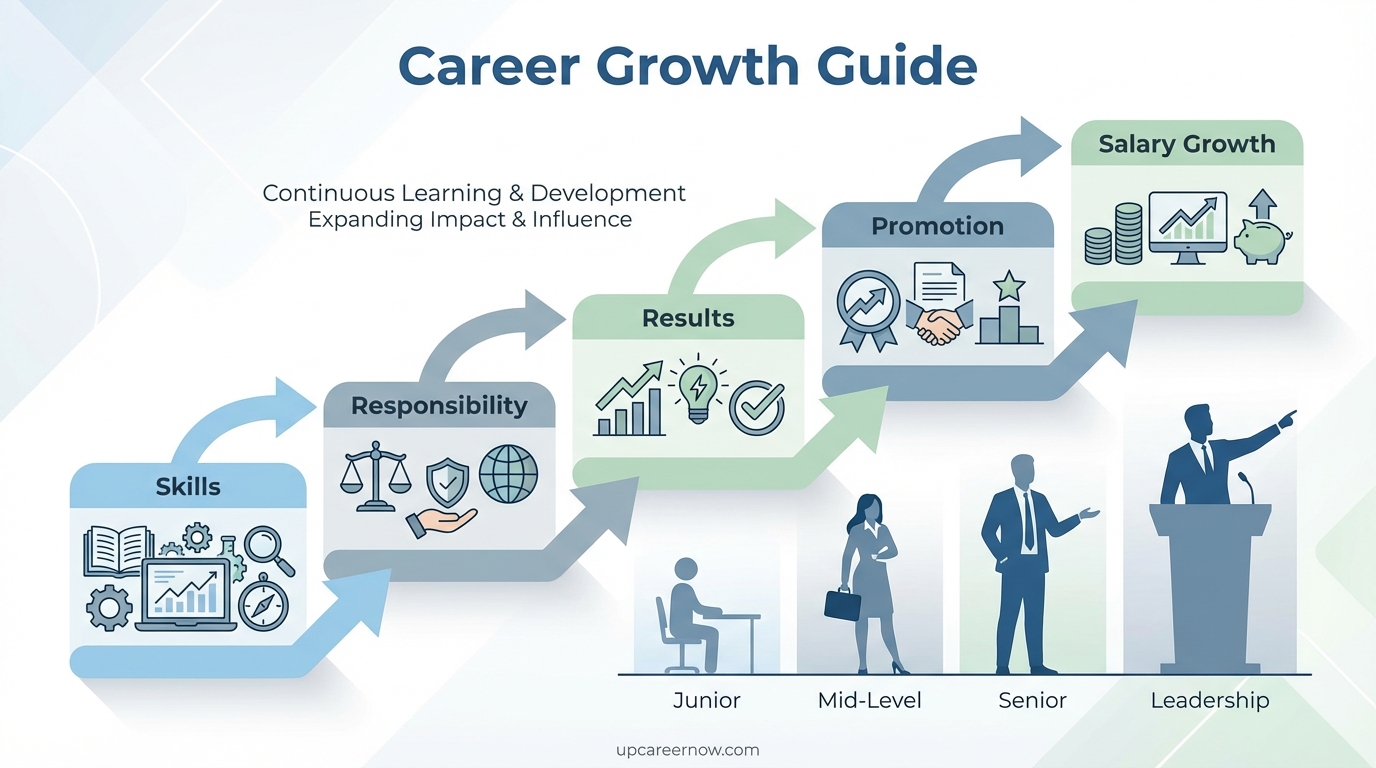
Salary growth makes the most sense when viewed as part of a larger system that includes skills, responsibility, and long-term planning. Our career growth guide explains how these pieces fit together over time.
Career growth creates the conditions for salary growth
Career growth typically happens first through:
- stronger skills
- increased responsibility
- clearer outcomes and impact
- higher trust and influence
Once these are established, salary growth becomes easier to justify and negotiate.
Salary growth is often “stepwise,” not smooth
Many careers follow a step pattern:
- long periods where salary stays the same
- short periods where it jumps (promotion, role shift, band change)
This is why salary growth can feel unfair if you expect linear improvement. The real goal is to build the inputs that lead to the next step.
The most stable path: skill → scope → results → pay
A reliable way to think about it:
- skills create capability
- scope gives you responsibility
- results build proof
- pay follows once proof is clear and repeatable
If your career growth doesn’t include scope expansion, salary growth often stalls—even if you’re working hard.
A calm way to use this
Instead of asking “Why isn’t my pay increasing?” ask:
- What scope am I trusted with now compared to 6 months ago?
- What measurable outcomes can I show?
- What responsibilities would justify the next pay level?
Those answers guide your next move more effectively than frustration.
Limitations & Disclaimer
Salary growth varies widely depending on role, industry, location, organization size, timing, and individual performance. This article explains common patterns and signals, not guarantees. Pay progression may be influenced by factors outside your control, including budget cycles, organizational structure, and market conditions.
Career information on UpCareerNow is provided for general guidance and planning purposes only. Actual outcomes depend on skills, experience, location, and market conditions.
Use this guidance to inform decisions—not as a promise of specific salary outcomes.
Ad & Content Safety Note
This content is educational and informational. It does not provide financial advice, income guarantees, or job placement promises. Salary growth depends on multiple variables, including performance, responsibility, and employer policies.
Author Bio
Written by: UpCareerNow Career Research Team
Role: Career & Skills Analyst
The UpCareerNow Career Research Team studies career progression, compensation structures, and workforce trends. Their work focuses on helping professionals understand how salary growth actually works so they can make informed, low-risk career decisions over time.
FAQs
What is salary growth in simple terms?
Salary growth is the increase in pay over time that usually follows greater responsibility, measurable impact, and trust—not just tenure.
Why does salary growth feel slower than effort?
Because pay increases often lag behind performance. Review cycles, budgets, and consistency requirements delay visible salary changes.
Does switching jobs always increase salary growth?
No. Switching helps when scope and responsibility increase. Lateral moves without growth often delay long-term salary progression.
How long does salary growth usually take?
Many people see signals within 6–12 months, but meaningful salary growth often happens in steps rather than gradually.
What blocks salary growth the most?
Limited role scope, flat pay bands, lack of measurable impact, and roles without progression paths commonly cap salary growth.
Hey Google, how does salary growth actually work?
Salary growth works when skills lead to responsibility, responsibility leads to results, and results are sustained long enough to justify higher pay.
References
- U.S. Bureau of Labor Statistics — Occupational outlook and skills/pay context
- OECD — Skills and employment outlook reports
- World Economic Forum — Workforce and skills trend insights